
FREE TRADING COURSE
1 - Broker Setup
2 - Risk Management
3 - Trading Philosophy
4 - Support & Resistance
5 - VWAP & Trend Structure
6 - Volume & Relative Strength
7 - Dip & Rip Strategy
8 - Day Trading Plan
10 - Moo - Moc
11 - How to interpret real-time news
9 - Journaling & Previewing Trades
Bonis Real Market Examples
Real Winning Trades
Trading Terms Index
Putting It All Together

At its highest-level trading is not the study of stocks. It is not the study of charts, indicators, or scanners. Trading is a study of human judgment under conditions of uncertainty. It is the study cognition emotional regulation, probability, and decision making in an environment specially designed to provoke irrational behavior. Every second a traitor sits in front of the screen, He is confronted with ambiguity, incomplete information, and constantly changing probabilities, the market does not offer certainty. It offers possibilities, and the traders’ task is to make rational decisions in the presence of uncertainty.
This is why trading is, fundamentally, a psychological discipline before it's a fundamental one. The market continuously activates some of the most powerful forces in human behavior: Fear, greed, anticipation, regret, overconfidence, loss aversion, impulsivity, and the fear of missing out. The average person believes that trading is simply a matter of finding the right stock. The experienced trader eventually realizes that the real battle is internal. The market becomes a mirror reflecting own strengths and weaknesses. It exposes impatience, ego, emotional reactivity, and our desire to be right.
Every trade presents four possible decisions. The first is whether to enter a position. The 2nd is whether to remain patient and do nothing. The 3rd is whether to realize a gain. The fourth is whether to accept the loss. Most beginners become obsessed with only one of these three decisions: Entering the trade. They spend years searching for the perfect setup while largely ignoring the psychology of restraint, the discipline of patience, and the intellectual humanity required to admit that a thesis is no longer valid.
One of the most sophisticated forms of intelligence in trading is the ability to do nothing. Human beings possess a natural bias towards action. We often equate movement with progress and activity with productivity. The market exploits its tendency. It creates urgency and the illusion that opportunities are constantly disappearing. This psychological pressure to do impulse decisions and unnecessary trades. The discipline trader understands something profound: Inaction can be highly intelligent decision. Cash is a position. Patience is a strategy. Restraint is often a competitive advantage.
There is a reason why some of the greatest scientists and philosophers in history were fascinated by uncertainty. Albert Einstein once said,” As far as the laws of mathematics refer to reality, they are not certain, and as they are certain, they do not refer to reality.” Weather one fully agrees with that statement or not, it contains a profound lesson for traders. The market is reality in his most dynamic form. It's a living system imposed of millions of human beings making decisions simultaneously, all acting on different information, emotions, expectations, and biases. Therefore, no equation, indicator, or model can predict the future with absolute certainty.
A disciplined trader eventually learns to think less like a fortune teller and more like a scientist. He forms a hypothesis, gathers evidence, observes behavior, and continuously updates his conclusions as new information becomes available. Every chart pattern, every news of that comment every change in volume coming and every shift is settlement slightly Altars the probabilities. The question is never,” What will the stock definitely do?” The more sophisticated question becomes,” What are the probabilities, how are they changing, and are the odds significantly in my favor to justify taking this risk?”
If a trader has a setup that historically works 70% of the time, then mathematically speaking, He does not need to know which individual trade will succeed or fail. Over a significantly large sample size, the mathematics can work in his favor, provided he remains disciplined and manages risk properly. This is where philosophy and mathematics intersect. The market teaches humility because it reminds us that certainty does not exist. The trader learns to become comfortable with the uncertainty and to think in terms of probabilities rather than predictions.
Another profound lesson in trading is learning to accept losses. The human mind possesses a deep aversion to being wrong. We become emotionally attached to our opinions and seek evidence that confirms our existing benefits. The market punishes its tendency relentlessly. A trader who cannot accept the loss often begins to negotiate with reality itself. He hopes, rationalizes, and waits for the market to validate his original opinion. The disciplined trader understands that a loss is not a mortal failure or an attack on one's intelligence. It is simply information. It is feedback, it is evidence that the pullbacks have changed or that the original premise no longer exists.
Paradoxically, success can be just as dangerous as failure. A series of profitable trades can generate overconfidence and the illusion of certainty. The trader begins to behave that he has mastered the market rather than simply navigating probability. Humanity becomes essential because markets have a way of Reminding participants that uncertainty never disappeared. Every new trade exists independently of the last. yesterday's success does not guarantee tomorrow's outcome.
As traders mature, they begin to recognize that the market is one of the greatest laboratories ever created for observing human behavior It is a living study of crowd psychology. Millions of people are making decisions every day based on emotion, perception, and expectation. Fear and greed become visible and price moves. Euphoria becomes visible and parabolic moves. Panic becomes visible and sharp declines. Human behavior leaves footprints.
There is an old observation that most people will do most of the same things most of the time. In many respects, the market validates this idea repeatedly. Crowds often become optimistic near highs and fearful near lows. They chase strength, avoid discomfort, and seek certainty where none exists. The experienced trader eventually learns that understanding human behavior may be just as important as understanding technical analysis. If you can remain calm while others become emotional, if you could think rationally while others panic, and if you could recognize what the crowd is likely to do next, you have developed an extraordinary edge.
This is why emotional regulation and mental clarity become so important. Many psychiatrists have often recognized the relationship between environment and cognition. Calm environments tend to promote clearer thinking and reduce unnecessary mental noise. The same principle applies to trading. A cluttered environment can contribute to a cluttered mind. A cluttered mind often produces impulse decisions. Meditation quiet reflection, deep concentration, and periods of uninterrupted study are not merely lifestyle choices, they can become tools for improving judgment and cognitive performance under pressure.
Ultimately, trading is not predicting the future with certain it is about making intelligent Decisions repeatedly in an uncertain world. It is about mastering judgment, regulating emotion, understanding probabilities coming and recognizing the recurring patterns of human behavior. Sometimes the correct decision is to enter a tray. Sometimes is to take a profit. Sometimes it is to accept a loss. And sometimes the most intelligent and disciplined decision is to do absolutely nothing at all.
At its deepest level, trading is not merely the buying and selling of stocks. It is the lifelong pursuit of mastering uncertainty, understanding people, and mastering oneself.

The philosophy of trading: From Socrates to Alexander
Most people think trading begins with charts, indicators, Scanners, or finding the perfect setup. The more I studied the markets, the more I realized that trading is actually a study of human nature. Every Candlestick represents human emotion. Every spike in price represents fear, greed, hope, panic, confidence, or uncertainty. The market is nothing more than millions of people making decisions under pressure. Because of that, I came to believe that before you can truly understand the market, you must first understand how to think. That journey led me not to Wall Street, but to ancient Greece and four extraordinary men whose ideas still influence the way we make decisions today: Socrates, Plato, aristotle, and Alexander the Great.
Socrates thought that wisdom begins with Humility and with the courage to question everything. His famous statement,” I know that I know nothing,” Maybe one of the most important lessons a trader could ever learn. The market punishes arrogance and rewards intellectual honesty. Every catastrophic loss often begins with the traitor becoming absolutely certain that he cannot be wrong. Socrates would ask difficult questions: Why do I believe this stock is going higher? What evidence suggests that I may be wrong? Am I looking at facts, or am I simply defending my opinion? To Socrates, the unexamined life was not worth living, and to a trader, the unexamined trade is equally dangerous. Every position should be treated as a hypothesis, never as an exact truth. The trader who continuously questions his assumptions becomes flexible, open minded, and capable of adapting when the market changes.
Plato then takes us one step deeper. He thought that human beings often mistake appearances for reality. In this famous allegory of The Cave, People watch shadows on a wall and believe those shadows are the entire truth. The market is filled with shadows. A stock surges on a headline, social media becomes euphoric, and traders chase the move believing they are seeing reality. But Plato would ask a different question: What is actually happening underneath? Is this a genuine improvement in the business, or is this merely a temporary emotional reaction? Is the stock being pushed by algorithms, trap shorts, or speculation? The disciplined trader learns that the price alone does not tell the entire story. The deeper reality often lies beneath the surface. Plato teaches us to think beyond the obvious and to search for the forces that are truly driving the market.
Aristotle transformed philosophy into something even more practical. He believed in observation, evidence, logic, and disciplined study. In many ways, Aristotle would have been perfectly suited to the world of trading. He would have studied every chart, journal every trade, analyze every mistake, and search relentlessly for recurring patterns. Aristotle understood that opinions had very little value unless they are supported by evidence. The market is uncertain, but uncertainty does not mean chaos. There are tendencies, probabilities, and behaviors that repeat themselves over time. The trader's job is not to predict the future with certainty, but to put the probabilities in its favor. Aristotle also believed that excellence is not a simple action, but a habit developed through repetition and discipline. Great traders are not created by one brilliant trade, they are built through thousands of small decisions, careful observations, a continuous refinement of their process.
Finally comes Alexander the Great. After all the questioning, all the searching for truth, all the analysis, there comes a moment when thought must become action. Alexander represents courage, the decisiveness, and execution. Many traders spend their entire lives studying but never fully trust themselves enough to act. Others hesitate, searching for perfect certainty that never arise. Alexander teaches that there is a point where preparation must give way to decision. A trader must accept that uncertainty can never be eliminated. He must place the trade, manage the risk, and accept the possibility of being wrong. Courage is not the absence of fear; it is the willingness to act despite uncertainty. Execution without thought becomes recklessness but thought without execution becomes useless. Alexander reminds us that knowledge only becomes valuable when it's applied.
The complete trader is therefore a combination of all four of these men. The trader must possess the humility of Socrates, always questioning his assumptions. He must process the vision of Plato, looking beyond appearances to find deeper truths. He must possess the logic and discipline of Aristotle, relying on evidence and probability rather than emotion an opinion. And finally, he must possess the courage of Alexander the Great, acting decisively when the moment demands it. In the end, trading is not merely the pursuit of money, it is an exercise in philosophy self discipline, and self mastery. The charts are only the surface. The real battle is within the mind of the trader, and the person who learns the master his own thinking may ultimately learn to master the markets as well.

ME.
People often ask me why I spend so much time studying trading, reading about the markets, and asking endless questions. The truth is simple: It has become an obsession. I don't mean obsession in a negative sense. I mean the kind of obsession that history repeatedly shows us is often present in people who pursue mastery in difficult disciplines. Albert Einstein became consumed by understanding the universe. Nikola Tesla became consumed by invention and ideas that never stopped occupying his mind. Galileo devoted his life to understanding the heavens despite enormous obstacles. Isaac Newton immersed himself in mathematics and physics with such intensity that he often neglected ordinary life. Too many people, that level of dedication appears excessive. To me, it appears to be a common thread among people who generally want to understand something at the deepest possible level.
Trading has become that pursuit for me. My typical day consists of 16 hours of continuous study, research, and trading. Even when the markets are closed, my mind is still thinking about probabilities, human behavior, market psychology, and why stocks move the way they do. I study charts, news, SEC filings, patterns, and the psychology behind the decision that people make under pressure. The markets have become endless intellectual puzzle, one that can never completely be solved and, perhaps, that is exactly why I find it so fascinating.
I realize that not everyone has to live this way. Not everyone has to become obsessed with trading, nor should they. This is simply my passion. I don't socialize very much. I don't spend my time pursuing countless hobbies or looking for ways to fill my day. This has become my life. This is what generally interests me. Some people are passionate about art, some about science, some about building businesses or writing books. I happen to be passionate about understanding the markets and understanding people. I have always believed that if you're going to dedicate a large portion of your life to something, then you should want to understand it as deeply as possible.
If I had to describe the mindset that I strive for as a trader, I would say that it's a combination of Sherlock Holmes and Spock. Sherlock Holmes represents relentless observation and the ability to notice details that everyone else overlooks. Spock represents logic, discipline, and emotional control. Trading demands both personalities simultaneously. You must observe like Homes and think like Spock. The market does not reward emotion. It rewards preparation, discipline, and the ability to remain rational while everyone else becomes emotional.
Some people see obsession as something unhealthy. I see it differently. I believe that extraordinary achievement often requires an extraordinary level of dedication. My obsession is not with money. It is with understanding. It is with learning. It is with trying to see the markets and human behavior a little more clearly each day. Every question I ask and every answer I uncover adds another piece to the puzzle. Every day I know a little more than I knew the day before.
Trading, for me, Not simply a profession or a hobby. It has become a lifelong intellectual pursuit. My 16 hour days are not a sacrifice. They are simply the expansion of a passion that I have never been able to turn off. This is my life, this is my passion coming and I could not imagine living any other way.

Broker Setup & Platform Basics
Before you begin trading real money, it is important to properly set up your broker and trading platform. Many beginners rush into the market without understanding once trading begins.
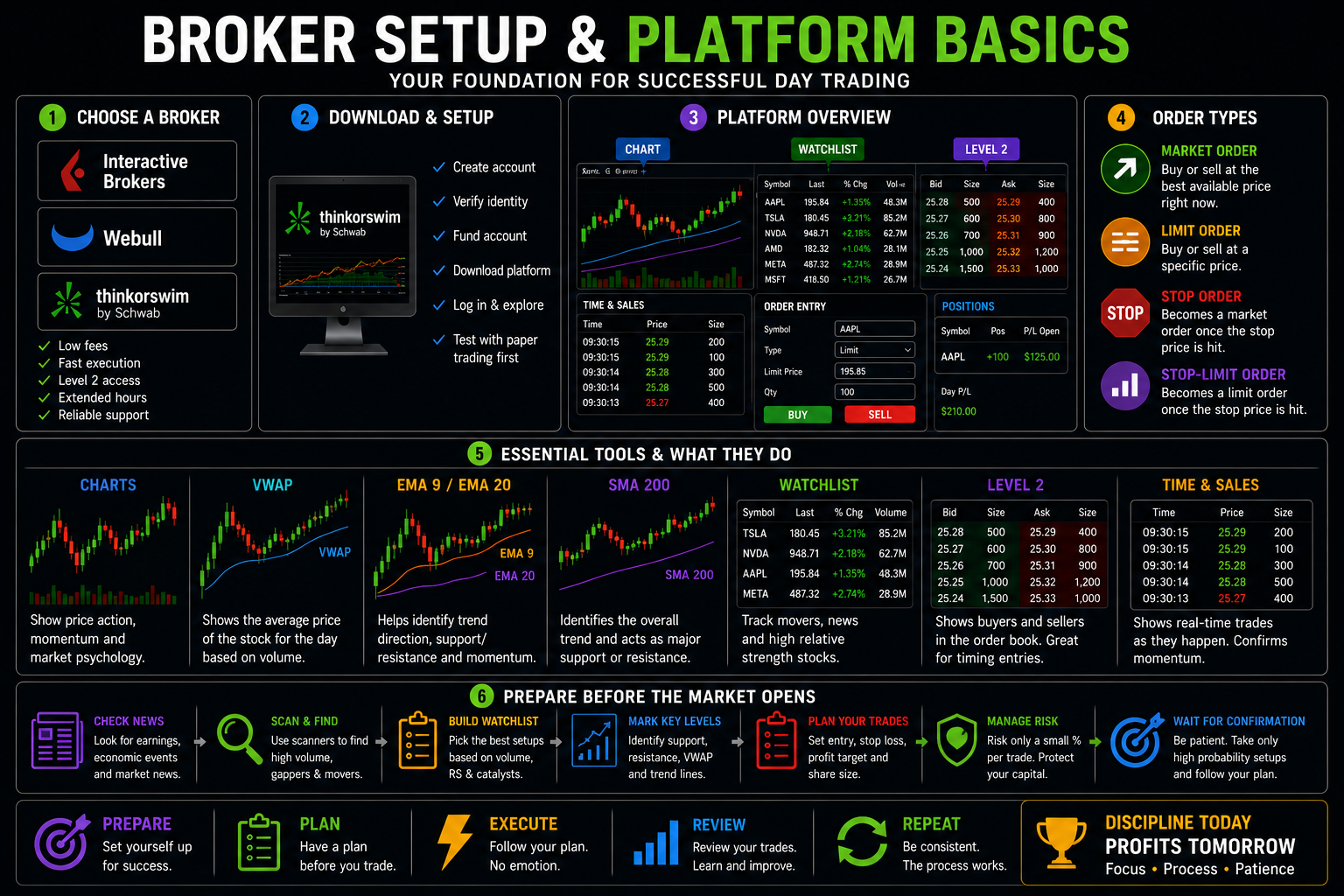
The first step is choosing a broker. Many traders use platforms such as Interactive Brokers we both, or Charles Schwab with the thinkorswim®️ platform. These brokers allow traders to access charts, level two data, watchlist, order entry systems, scanners, and extended hours trading. Beginners are encouraged to test platforms using their paper trading accounts before risking real money.
Once the platform is installed, traders should begin by learning the basic layout. Most professional trading platforms include charts, watchlist, level two data, time and sales, account balances, open positions, and order entry windows. Understanding where everything is located is critical during fast moving market conditions.
One of the first things traders should configure is the chart setup. Most traders use Candlestick charts because they provide clear information about price movement, momentum, and market psychology. Candlesticks show the opening price, closing price, highs, lows, and whether buyers or sellers controlled the candle.
Professional traders often add several important indicators to their charts. VWAP is one of the most important indicators because it shows the average price of the stock throughout the day while factoring in Volume. Traders also commonly use the EMA9, EMA20, and SMA 200 to help identify trend direction, support and resistance, and momentum shifts.
The watch list is another important tool. Traders use watch lists to shack stocks with strong news, unusual volume, earnings reports, high relative strength, or premarket movement. Instead of watching hundreds of stocks, professional traders narrow their focus to similar number of quality setups.
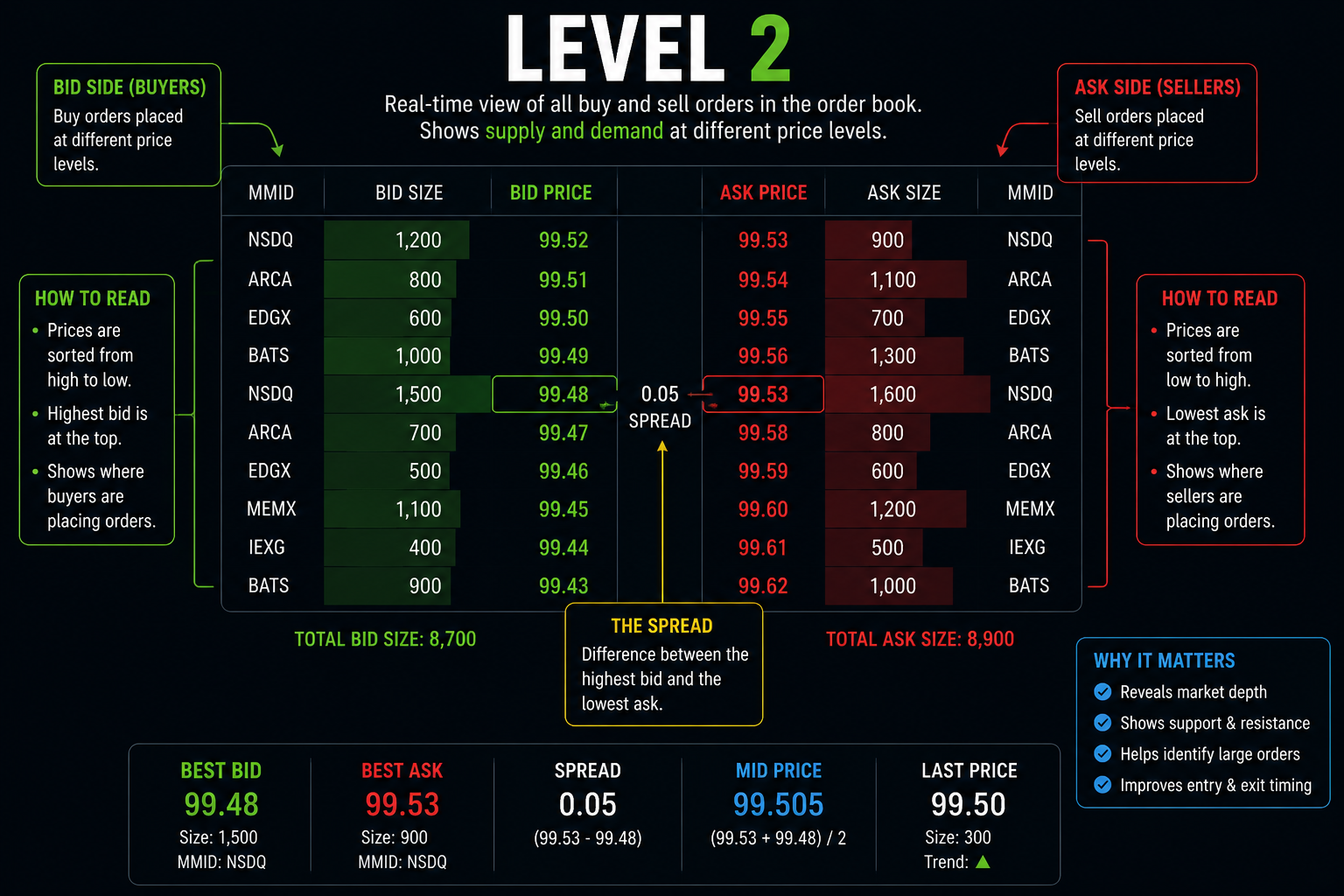
Level two and time and sales are also important features on professional trading platforms. Level 2 displays buyers and sellers sitting on the order book, while time and sales show actual transactions taking place in real time. These tools help traders understand short term momentum, liquidity, and possible support and resistance areas.
Border entry is one of the most important parts of the platform. Traders must understand the difference between market orders, limit orders, stop orders, and stop limit orders. Professional traders often prefer limit orders because they provide greater control over entries and exit during volatile conditions.
Beginners should also understand the difference between cash accounts and margin accounts. Margin accounts allow traders to use leverage access futures such as short selling and faster settlement times, but they also increased risk significantly. New traders should focus on learning discipline and consistency before using large amounts of leverage.
Extended hours trading is another important feature. Many brokers allow trading door in free market and after hour sessions. Stocks with major news often move aggressively outside normal market hours, which is why many momentum traders monitor premarket activity before the opening bell.
One of the best ways to learn a platform is through paper trading. Paper trading allows traders to practice using the platform, placing trades, managing risk, and testing strategies without risking real money.
The goal is not simply learning where buttons are located. The goal is building confidence, understanding platform functionality, and creating a professional trading environment before real money is involved. A strong platform set folks traders focus on execution, discipline, and decision making instead of confusion during live market conditions.

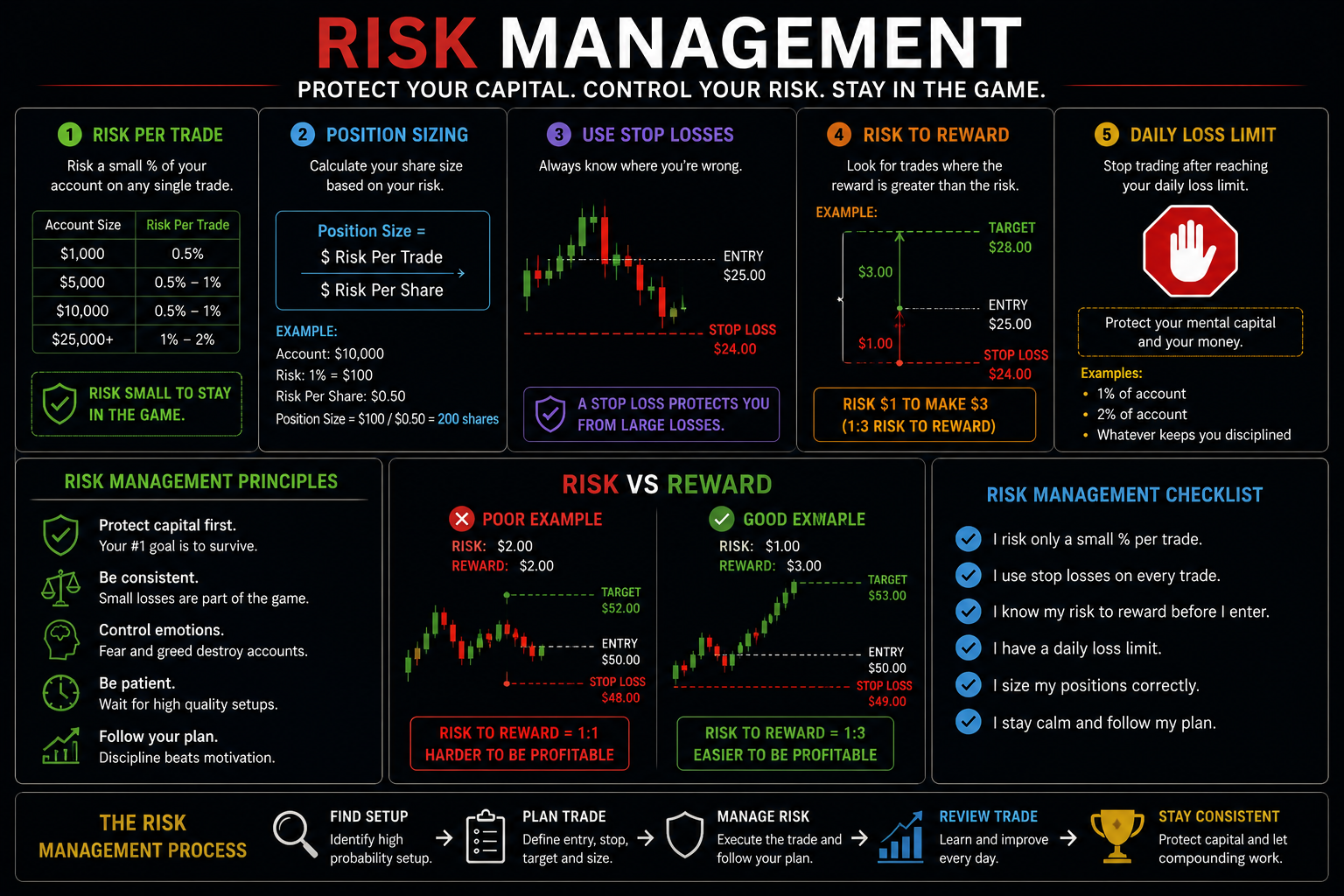
Risk management is one of the most important concepts in trading because it protects traders from catastrophic losses and helps create long term consistency. Many beginners focus almost entirely on profits, but professional traders focus first on Protecting capital. Without risk management, even strong strategies can fail over time.
The market is unpredictable. This setup works perfectly every time. Even the best traders in the world experience losing trades. The difference is that professional traders keep losses controlled while allowing winning trades to grow over time.
Risk management Begins before entering a trade. Professional traders already know how much they are willing to risk, where they will exit if the trade fails, and how large their position size will be. The planning helps remove emotional decision making during fast moving market conditions.
One of the biggest mistakes beginners make is risking too much money on a single trade. Oversized positions often cascade fear, panic, hesitation, and emotional decision making. Professional traders focus on staying emotionally calm by risking only amounts they are comfortable losing.
Stop losses are one of the most important risk management tools. A stop loss is a pre-determined exit point where a trader accepts that the trade idea failed. Professional traders use stop losses to protect capital and prevent small losses from becoming catastrophic losses.
Risk management also includes daily loss limits. Many profess trade or stop trading after reaching a certain daily loss amount. This helps prevent revenge trading, emotional decisions, and overtrading during frustrating market conditions.
Patience is another important part of risk management. Many beginners force trades out of boredom or excitement. Professional traders understand that not every market condition provides high quality setups. Sometimes protecting capital means waiting patiently instead of trading emotionally.
Position sizing is closely connected to risk management. Volatile stocks often require smaller positions because price can move aggressively in short periods of time. Stable stocks may allow slightly larger positions because the price action is more controlled.
Professional traders also focus heavily on risk to reward ratios. Instead of risking large amounts for small profits, they look for setups where the potential reward is larger than the potential loss. This allows traders to remain profitable even if not every trade works.
Emotional control is deeply connected to risk management. Fear, greed, frustration, and revenge trading are some of the biggest reasons traders lose money. Having predefined rules help traders stay disciplined and focus during both winning and losing streaks.
The goal of risk management is not avoiding all losses. Losses are part of trading. The goal is keeping losses small, protecting the account, and staying consistent over time. Traders who survived difficult market periods have the opportunity to continue learning and improving.
Professional traders understand that protecting capital comes first period the best traders combine risk management with VWAP, trend structure, support and resistance, volume, relative strength, discipline, and patience to build a long-term professional trading system.
Risk Management

Trading Philosophy
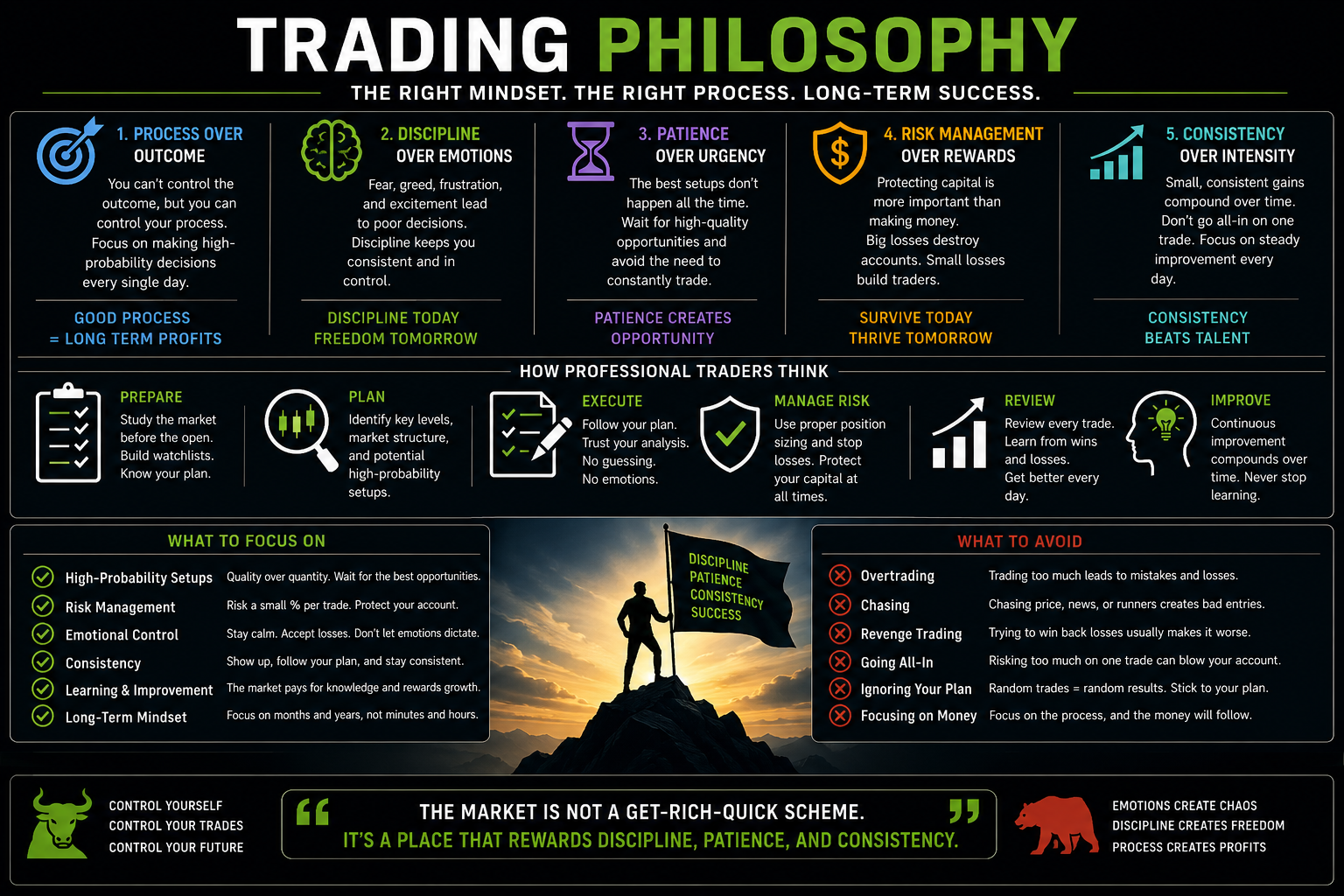
Trading philosophy is a foundation behind how a trader thinks, reacts, and survives in the market over time. Many beginners focus only on making money, but professional traders understand that long term success comes from discipline, patience, consistency, and emotional control. A strong trading philosophy helps traders remain focused during both on winning streaks and difficult market conditions.
The market rewards discipline and punishes emotional decision making. Fear, greed, frustration, revenge trading, impulsive decisions are some of the biggest reasons traders lose money. Professional traders constantly on controlling emotions and following a structured process instead of reacting emotionally to every move in the market.
Trading is not about being right on every trade. Even the biggest traders lose trades regularly. The goal is not perfection. The goal is managing risk, protecting capital, and consistently making high probability decisions overtime. Small controlled losses are part of professional trading, while large emotional losses often come from poor discipline and impulsive behavior.
Patience is one of the most important parts of trading philosophy. Many beginners feel pressured to consistently trade throughout the day. Professional traders understand that not every market condition provides quality opportunities. Sometimes the best trade is not a trade at all. Waiting for a confirmation quality setup often separates professional traders from emotional traders.
Consistency is more important than excitement. Many beginners chase huge wins and fast money, but professional traders focus on building steady habits and long-term performance. Small consistent gains combined with strong risk management can become extremely powerful over time.
A strong trading philosophy also includes preparation. Professional traders study the market before the opening bell, build watchlists, review news, identify key levels, and create plans before entering positions. Preparation reduces emotional decision making during fast moving market conditions.
Professional traders focus heavily on protecting capital. Without capital, there's no opportunity to continue trading and improving. This is why risk management, Position Sizing, stop losses, an emotional discipline are critical parts of professional trading mindset.
Learning from mistakes is another major part of trading philosophy. Every trade provides information. Professional traders review wins, losses, emotions, execution mistakes, and overall performance regularity. Continuous improvement is one of the biggest differences between long term traders and emotional gamblers.
The market consistently changes. Strategies evolve, momentum shifts, and conditions become stronger or weaker over time. Successful traders remain adaptable while continuing to follow disciplined principles and structured decision making.
The goal of trading philosophy is not simply making money quickly. The goal is building discipline, emotional control, consistency, patience, and long-term survival in the market. Professional traders understand that success comes from process, preparation, and risk management far more than excitement or gambling behavior.
The best traders combine discipline, patience, emotional control, risk management, preparation, VWAP, trend structure, support and resistance, volume, and consistency together to create a professional trading approach.

Support & Resistance
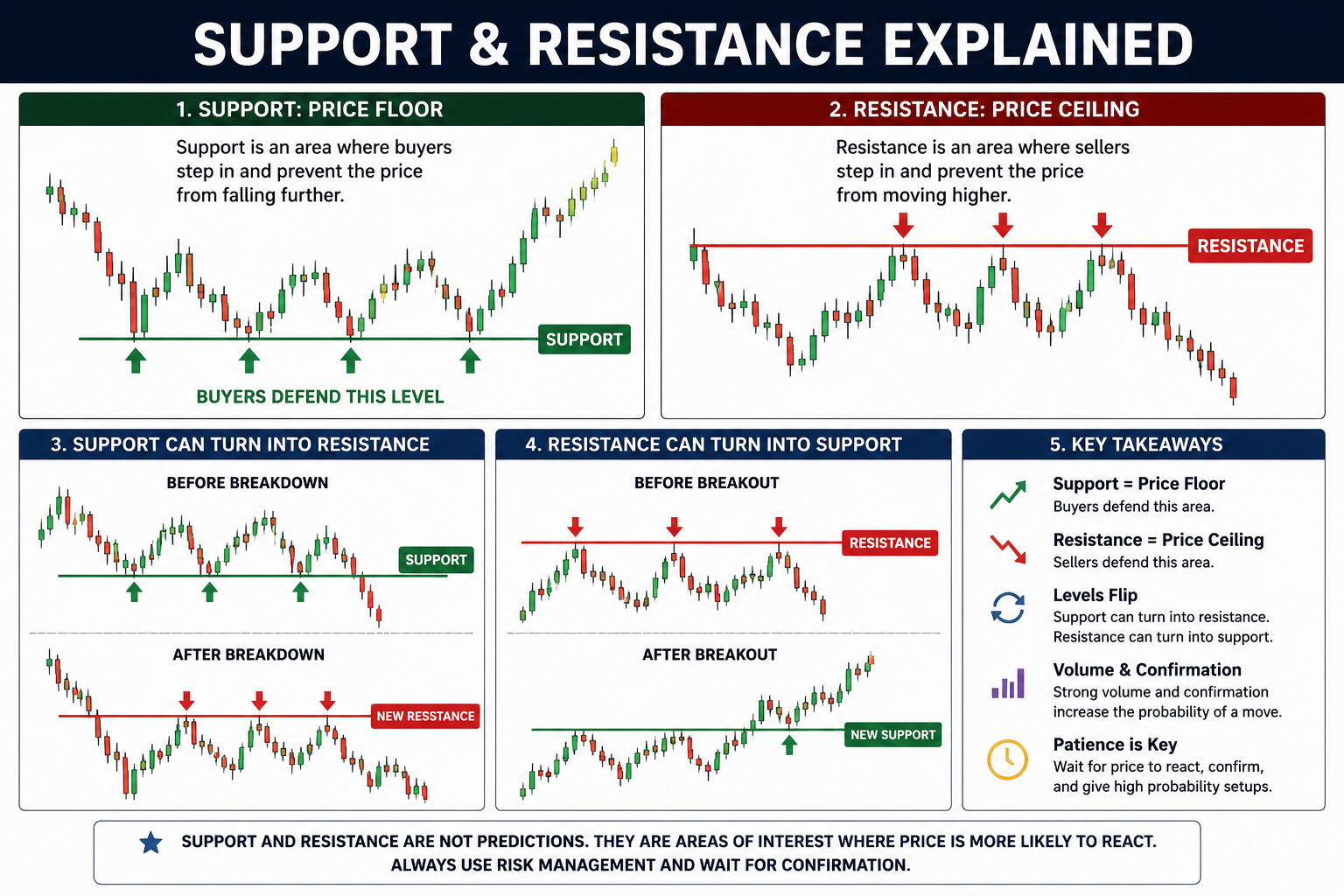
Support and resistance are some of the most important concepts in trading because they help traders understand where the price might react. These levels act as decision zones in the market where buyers and sellers battle for control. Learning how to identify these areas can help traders improve entries, exits, and overall timing.
Understanding support is an area where a stock tends to fall because buyers begin stepping in. It acts like a floor underneath the stock price. When a price approaches support, Traders often look for bounce or stabilization because demand may begin overcoming selling pressure.
The more times the stock reacts to a support level, the more important that level can become. Strong support levels often appear on the daily chart and are watched closely by professional traders.
Understanding resistance:
Resistance is the opposite of support. It is an area where price tends to struggle moving higher because sellers begin entering the market. Resistance acts like a Ceiling above the stock price.
When approaches resistance, traders often expect slowing momentum, pullbacks, or possible rejection. If price eventually breaks through resistance with strong volume, because sometimes lead to powerful breakout moves.
Why these levels matter:
Support and resistance help traders understand where important reactions may occur. Instead of entering trades randomly, traders use these levels to make more calculated decisions.
These areas can help identify better entry points, stop losses, breakout opportunities, and profit targets. Many professional traders build their entire strategy around how price behaves at key support and resistance zones.
Support becoming resistance:
One of the most important ideas in trading is that old support can later become resistance. If price breaks below a major support level, traders who previously bought there may sell when the price returns to that same area.
The opposite is also true. Old resistance can become new support after a successful breakout. This is why traders constantly watch previous highs, previous lows, and important breakout areas.
Patience around key levels:
Many beginners enter trades too early without waiting for confirmation. Professional traders are often more patient around support and resistant areas. They wait to see how price reacts before making decisions.
Strong candles, increasing volume, momentum, and confirmation signals can all help traders determine whether support or resistance is likely to hold or break.
Patience Is often what separates emotional trading from professional training.
Trading is about probability
Support and resistance are not guaranteed prediction tools. No level works perfectly every time. Sometimes support breaks. Sometimes resistance fails. False breakouts and fake moves happen regularly in the market. The goal is not perfection. The goal is to identify high probability areas where price is more likely to react and then manage risk properly around those areas.
The best traders combine support and resistance with volume, trend analysis, VWP, EMA’S and risk management to create stronger trading decisions.

VWAP & Trend Structure
VWAP and trend structure are two of the most important tools traders use to understand the direction, strength, and overall continuation of a stock. When combined together, they help traders avoid random entries and instead of trade with the momentum and structure of the market. Professional traders constantly watching VWAP and market structure because they help identify whether buyers or sellers are truly in control.
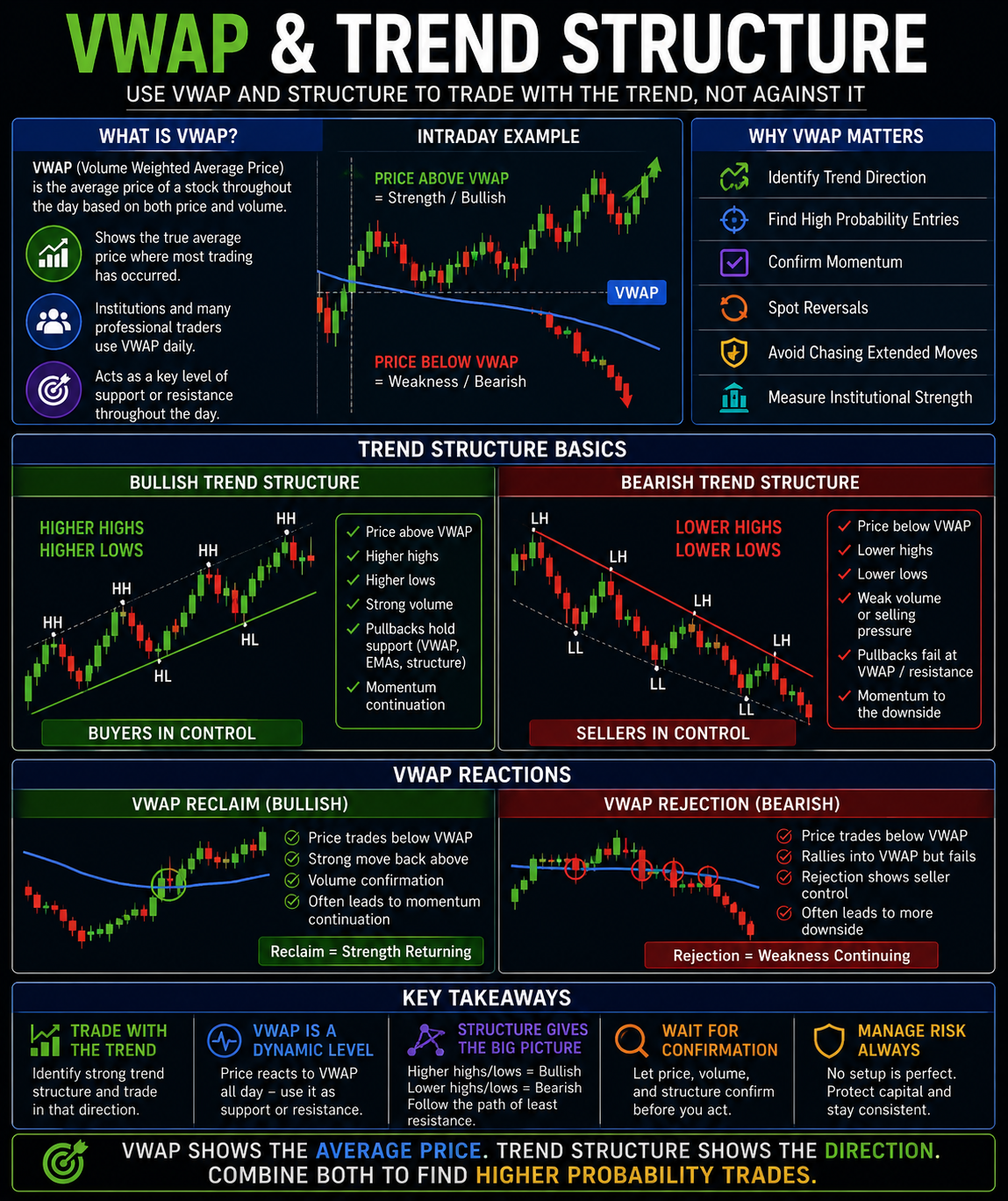
VWAP stands for Volume Weighted Average Price. It is one of the most widely used indicators in trading because it shows the average price of a stock throughout the day while taking volume into account. Unlike a simple moving average, reflects in both price and volume, making it a powerful indicator for understanding where institutions and large traders may be positioning themselves. Many professional traders view VWAP as a major decision area during the trading day When price is above VWAP, it often suggests strength and bullish momentum. When prices below VWAP, it can suggest weakness and bearish pressure. Because so many traders watch VWAP, stocks often react strongly around this level.
VWAP helps traders determine whether a stock is trading with strength or weakness relative to the average price throughout the day. Professional traders often use VWAP to identify trend direction, confirm momentum, spot reversals, avoid chasing extended moves, and measure institutional strength. VWAP is essentially important for intraday trading because it helps traders understand whether buyers or sellers currently control the market.
Trend structure refers to the way price moves over time. A healthy uptrend usually forms higher highs and higher lows, while a healthy downtrend forms lower highs and lower lows. Understanding this structure helps traders identify whether momentum is strengthening or weakening. Instead of reacting emotionally to every candle, traders focus on larger structure developing on the chart.
In a bullish trend, buyers remain in control. Price continues making higher lows while pushing into higher highs. Call backs are usually temporary and often hold important support areas such as VWAP, EMA levels, or previous breakout zones. Strong bullish structure often includes price holding above Diwali, strong volume, healthy pullbacks, and continued momentum. Professional traders often wait for pullbacks into support instead of chasing standard moves.
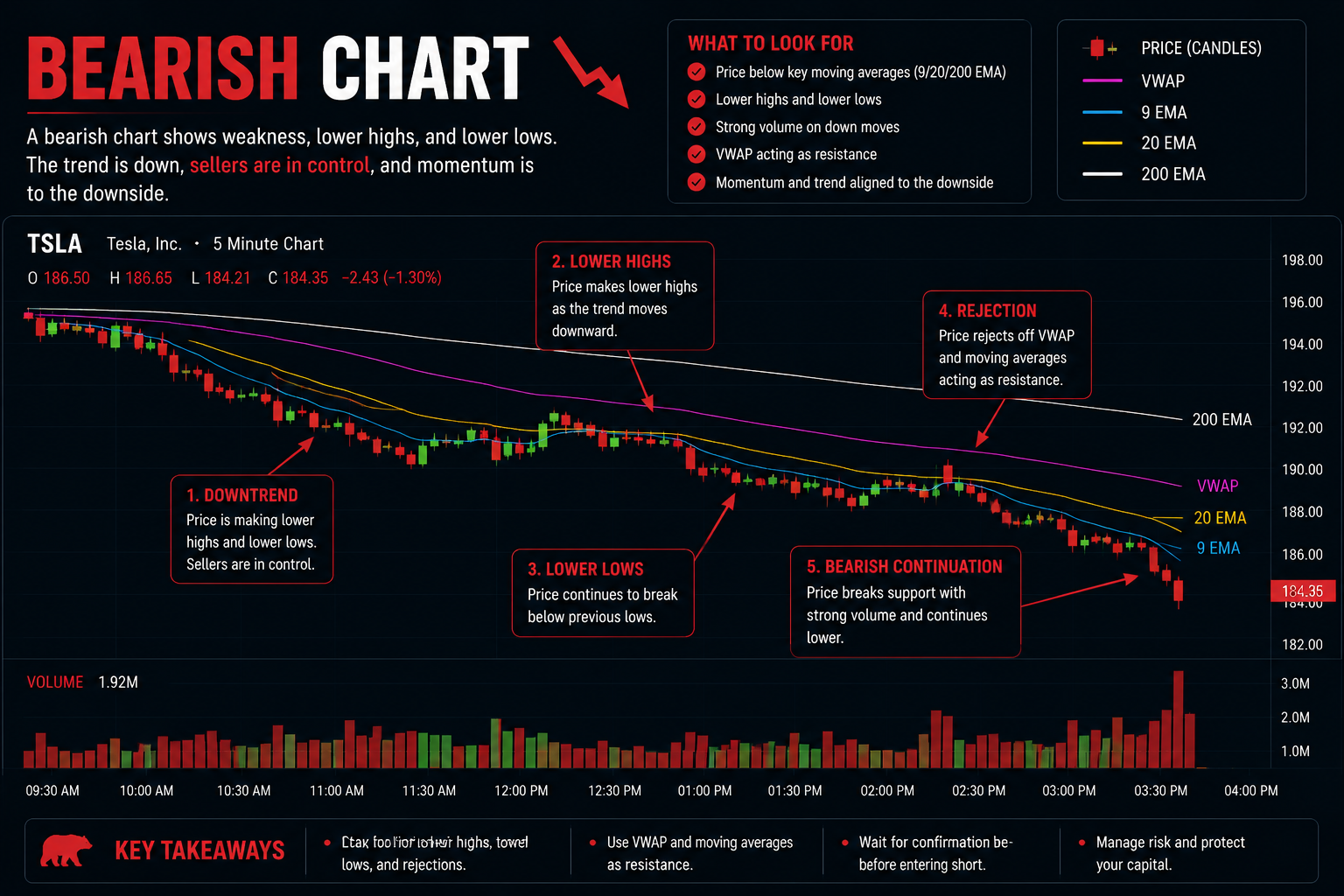
In a bearish trend, sellers control the stock. Price begins making lower highs and lower lows while struggling to reclaim important levels like VWAP or previous resistance voles. Weak stocks often fail at we VWAP repeatedly before continuing lower professional traders use this structure to avoid buying weak setups and to identify possible breakout opportunities.
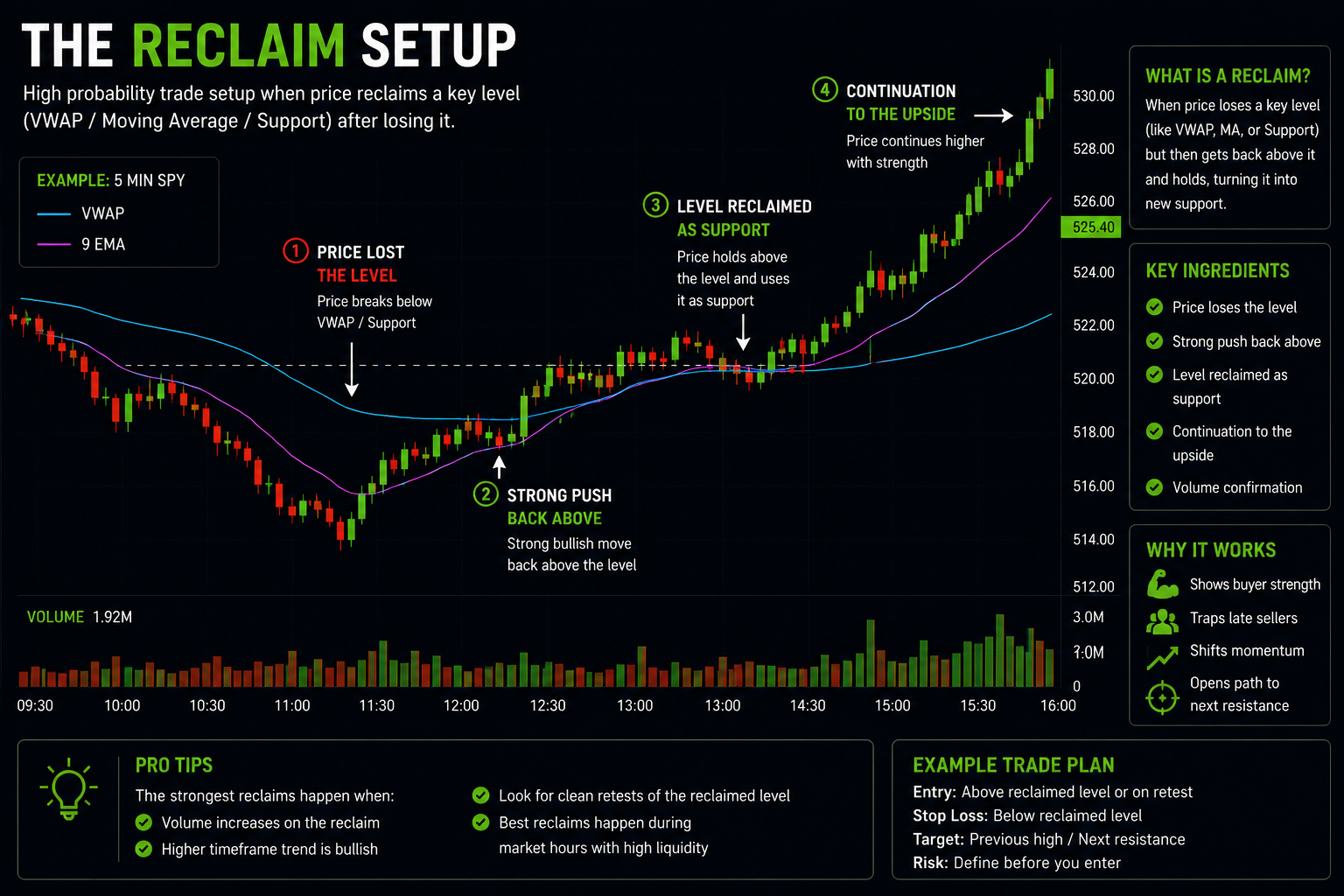
One of the most important concepts in trading is the VWAP reclaim. When price goes back above VWAP after trending below it, this can sometimes signal returning strength and momentum. Traders often look for volume confirmation and strong candles during these reclaims. The opposite can also happen. The price repeatedly rejects from VWAP, it may signal continued weakness and bearish pressure. These reactions around VWAP are heavily watched by both retail and institutional traders.
Many beginners enter trades too early simply because price starts moving quickly. Professional traders usually wait for confirmation. They watch how price reacts around VWAP, key support and resistance levels, trend structure, volume, and momentum before entering trades. Patience helps traders avoid fake breakouts, emotional entries, and unnecessary losses.
The goal is not to predict every move perfectly. The goal is to trade with structure, momentum, and probability. VWAP and trend structure help traders identify when the odds may be shifting in favor of buyers or sellers. The best traders combine VWAP, support and resistance, volume, trend structure, EMA’S and risk management together instead of relying only on one indicator alone.

Volume & Relative Strength
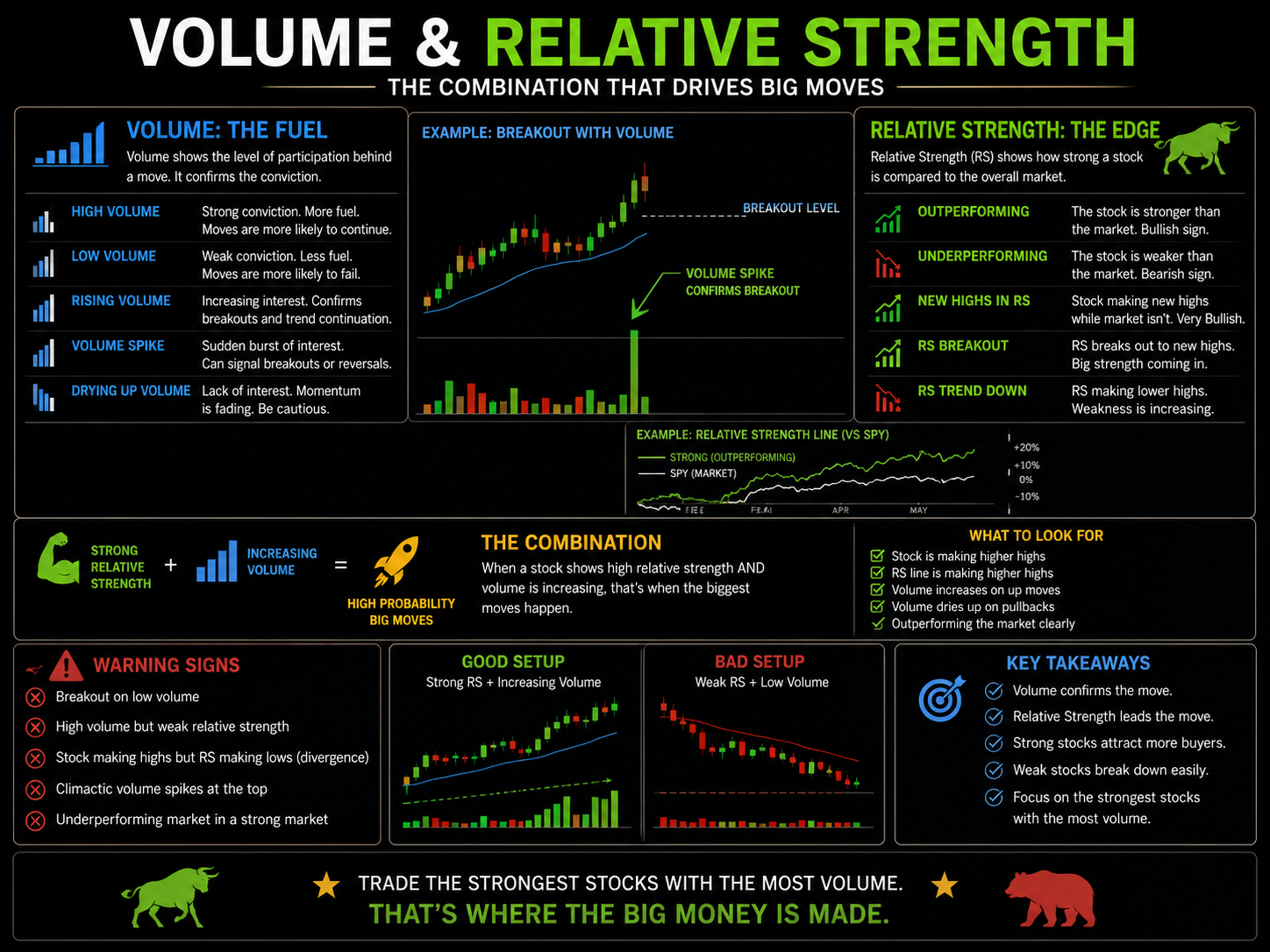
Volume and relative strength are two of the most important concepts traders use to measure momentum, conviction, and the truth strength of a stock, Price movement alone does not tell the full story. A stock can move up or down, but the volume and relative strength help traders understand whether the move is actually meaningful or likely to continue.
Professional traders constantly monitor volume and relative strength because they help identify where momentum is building and where institutions may be positioning themselves.
Volume represents the number of shares being traded during a specific period of time. High volume often means there is increased interest, participation, and emotion in the stock. Low volume usually suggests weaker interest and less conviction behind the move.
When a stock moves higher with strong volume, it can indicate aggressive buying pressure and growing momentum. When a stock moves higher with weak volume, the move may be less reliable because there is not enough participation supporting the breakout.
Relative strength refers to how strong a stock is compared to the overall market or compared to other stocks in the sector. A stock showing relative strength continues holding up well even when the market pulls back or becomes weak.
For example, if the market is red but a stock continues pushing higher or consolidating strongly near hives, traders may view that stock as having strong relative strength. These are often the stock's institutions and momentum traders focus on because they are showing leadership.
The opposite is also true. A stock showing relative weakness may continue falling even when the overall market attempts to bounce. This can signal weakness, selling pressure, or lack of institutional interest.
Professional traders often look for stocks with both strong volume and strong relative strength because this combination can create powerful momentum opportunities. Stocks with heavy volume and strong relative strength tend to attract more traders, more attention, and sometimes larger directional moves.
Volume also helps traders identify possible reversals and exhaustion. Extremely high volume after a large move can sometimes signal panic selling, profit taking, or emotional buying near a temporary top or bottom. Understanding the context of volume is critical.
Many beginners focus only on price movement while ignoring volume completely. Professional traders understand that volume confirms the quality of the move. A clean breakout with increasing volume is usually much stronger than a breakout on weak participation.
Relative strength also helps traders focus on the strongest opportunities instead of randomly trading weak stocks. Professional traders prefer to trade stocks showing leadership, momentum, and constant buying pressure rather than stocks struggling below key levels.
The goal is not to simply to find stocks moving. The goal is to find stocks moving with confirmation, participation, and strength. Volume and relative strength help traders identify when momentum is real and when the odds made favor continuation instead of failure.
The best traders combine volume, relative strength, VWAP, trend structure, support and resistance, and risk management together to build higher probability trading decisions.

Dip & RIP Strategy
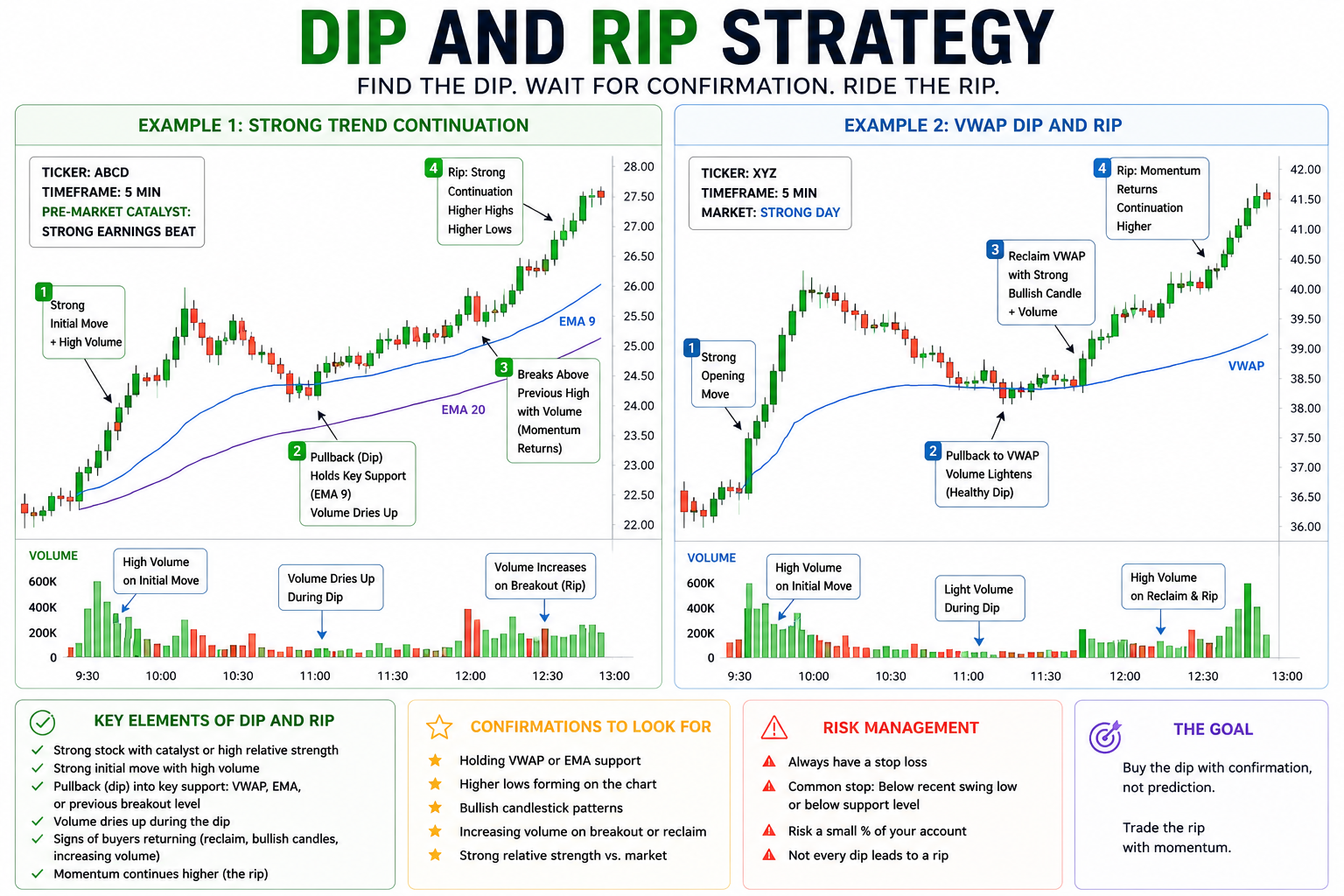
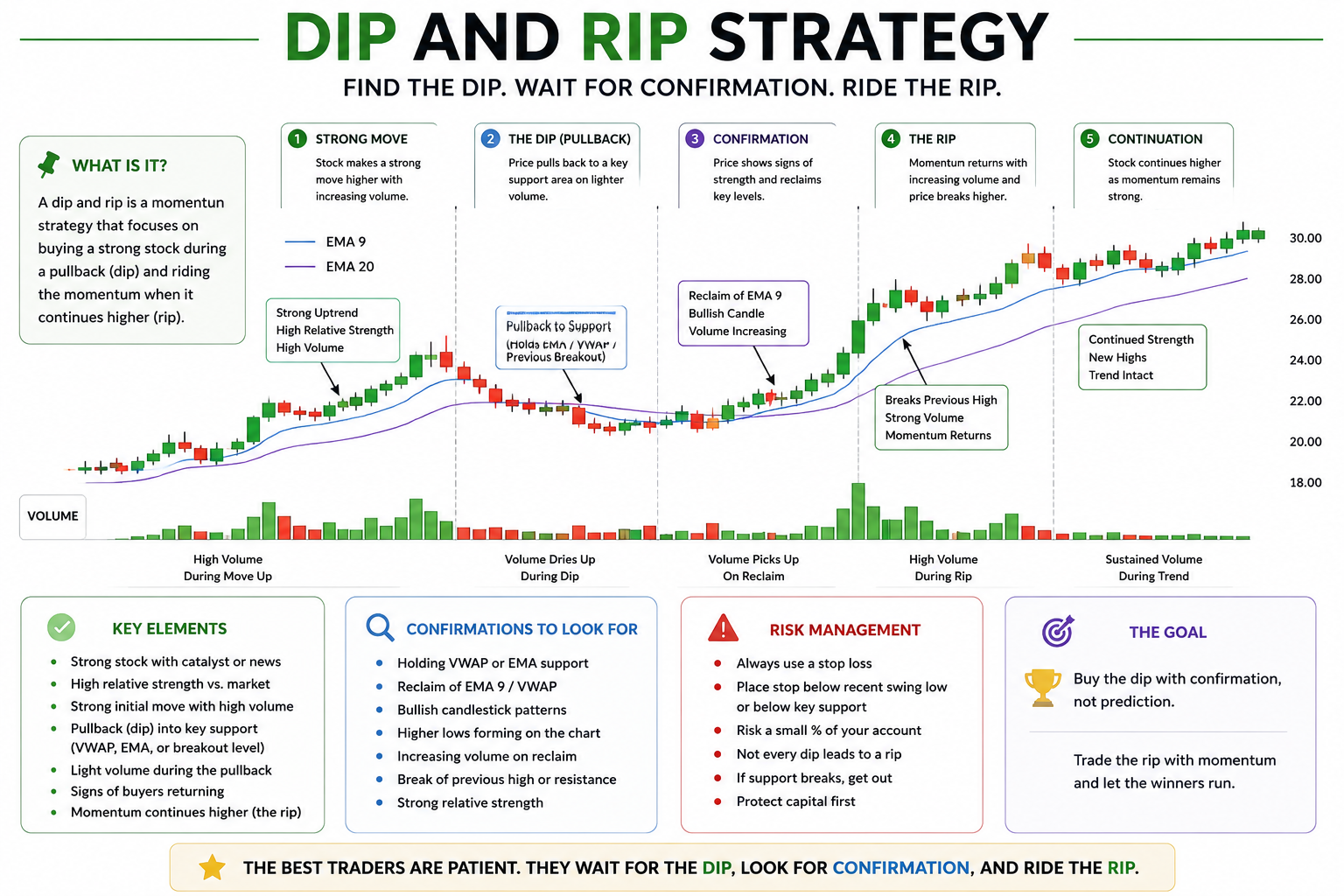
The DIP and RIP strategy is one of the most popular momentum trading setups used by both beginner and professional traders. The strategy focuses on identifying strong stocks that temporarily pull back before continuing higher instead of chasing a stock at the top of a fast move, traders wait for the pullback, or dip, and then look for confirmation that momentum is returning before entering the trade.
This strategy is popular because stocks rarely move straight up without pauses. Even the strongest momentum stocks often experience temporary pull backs before continuing their trend. Understanding how these pullbacks work can help traders improve entries and avoid emotional chasing.
A dip usually happens after a strong move higher. Traders who bought early May begin taking profits, short sellers may step in temporarily, or momentum may slow down for a short period of time. This causes price to pull back towards important support levels such as, EMA levels, previous breakout zones, or key support areas.
Professional traders do not panic during healthy pullbacks. Instead, they watch carefully to see whether the stock is holding structure and whether buyers are beginning to regain control.
Hold support and starts reclaiming important levels with increasing volume.
Many professional traders look for several confirmations before entering a DIP and RIP setup. These may include strong relative strength, increasing volume, VWAP reclaimed, high or lows forming on the chart, strong Candlestick reactions, or momentum returning after the pullback stabilizes.
Volume is extremely important during a DIP and RIP setup A stock pulling back on light volume can sometimes suggest that sellers are weak and that the move is simply a temporary pause. When buyers stepped back in with increasing volume, momentum can quickly accelerate again.
Patience is one of the most important parts of this strategy. Many beginners enter too early while the stock is pulling back aggressively. Professional traders often wait for signs that selling pressure is slowing down and that buyers are regaining control before entering the trade.
Risk management is critical with dip and rip trading because not every pullback leads to continuation. Sometimes the stock loses momentum completely and continues lower. This is why traders often use stop losses underneath important support levels to control risk.
The best DIP and RIP setups usually happen on stocks with strong catalysts, high relative strength, strong volume, and overall bullish market momentum. Stocks that are already leading the market all of them provide cleaner dip and rip opportunities because momentum traders continue focusing on them throughout the day.
The goal of the dip and rip strategy is not to blindly buy every pullback. The goal is to identify strong stocks pulling back and to support and then wait for a confirmation that momentum is returning before entering the trade.
Professional traders combine DIP and RIP setups with VWAP, support and resistance, volume, trend structure, relative strength, and risk management to build higher probability trading opportunities.
.

Day Trading Plan
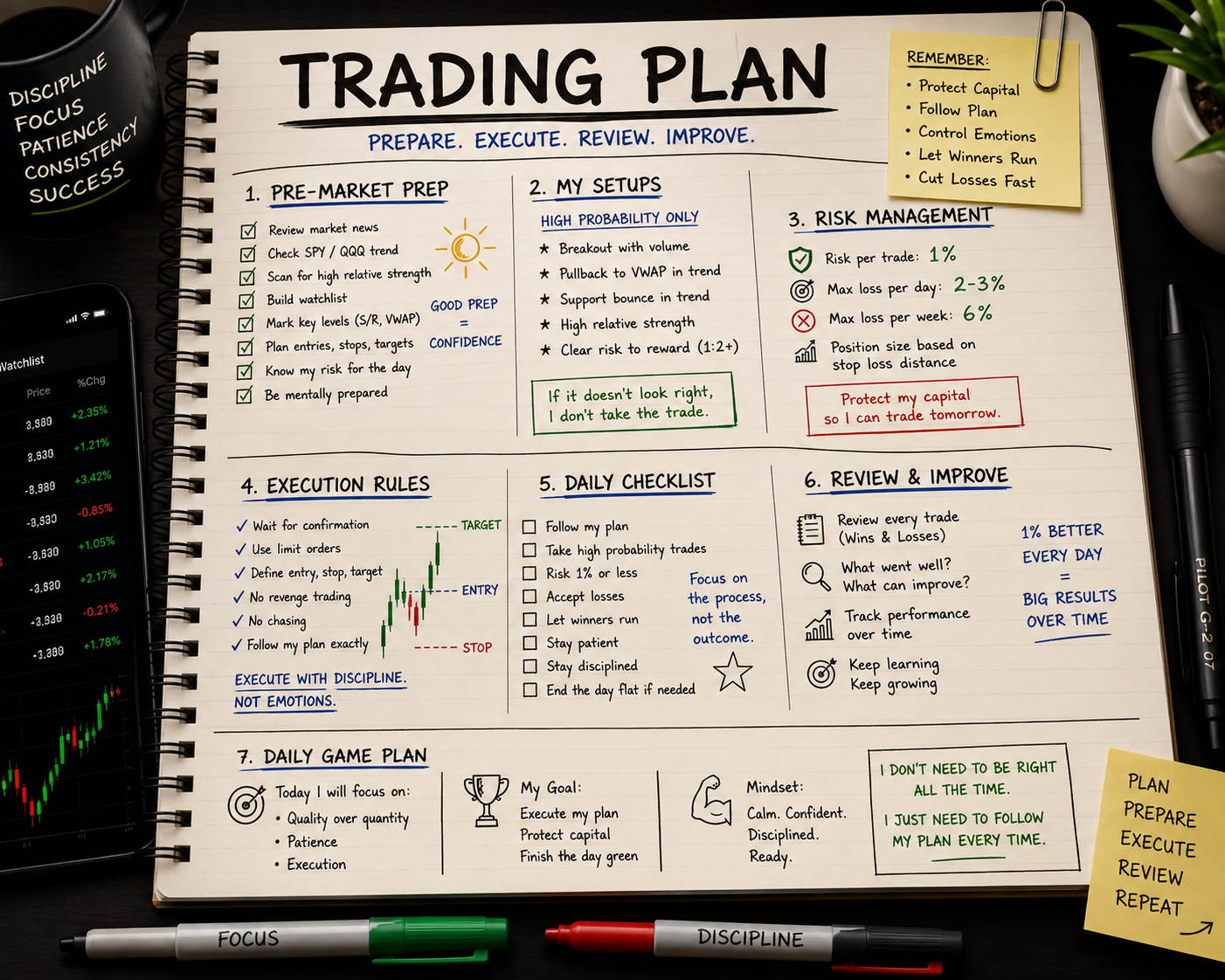
A day trading plan is one of the most important tools a trader can develop. Professional traders do not enter the market randomly or emotionally. They follow a structured process designed to protect capital, improved discipline, and increased consistency over time.
A trading plan helps remove emotional decision making by creating rules and structure before the trading day even begins. Without a plan, many beginners end up chasing stocks, over trading, revenge trading, or taking unnecessary risks.
A professional training day usually begins long before the market opens. Traders often wake up early to study premarket movers, overnight news, earnings reports, economic events, and overall market conditions. Understanding the environment before the opening bell helps traders remove mentally and identify potential opportunities before momentum begins.
Many traders create a watchlist before the market opens. This watchlist usually includes stocks with strong catalysts, unusual volume, high relative strength, major news, earnings reports, or strong free market movement. Instead of watching hundreds of stocks, professional traders narrow their focus to smaller group of higher quality opportunities.
Risk management is one of the most important parts of trading plan. Professional traders decide in advance how much they are willing to risk per trade and how much they are willing to lose during the day before they stop trading. This helps prevent emotional decisions and protects the trading account from major damage.
A good trading plan also includes entry rules. Traders define exactly what they are looking for before entering a position. This may include support and resistance levels, VWAP reclaim, volume confirmation, trend structure, relative strength, EMA support, breakout confirmation, or DIP and RIP setups. Having clear rules helps traders avoid impulsive entries.
Professional traders also create exit plans before entering trades. They identify potential profit targets, resistance levels, trailing stop areas, and stop losses ahead of time. Planning exits in advance helps traders remain calm during fast moving market conditions.
Patience is a major part of a successful day trading. Many beginners feel pressure to constantly trade throughout the day. Professional traders understand that not every minute provides high quality setup. Sometimes the best decision is waiting for a clean confirmation and strong probability instead of forcing trades out of boredom or emotion.
Reviewing trades is another important part of a trading plan. Professional traders often review their wins, losses, mistakes, and emotional decisions after the market closes. Study in previous trades helps traders improve discipline, identify weaknesses and refine their strategies over time.
A trading plan also helps traders maintain emotional control. Fear, greed, frustration, excitement, and revenge trading are some of the biggest recent traders lose money. Having structure and rules helps traders stay focused on process instead of emotion.
The goal of a trading plan is not perfection. The goal is consistency, discipline, and long-term survival in the market. professional traders understand that protecting capital.

Journaling and Reviewing Trades
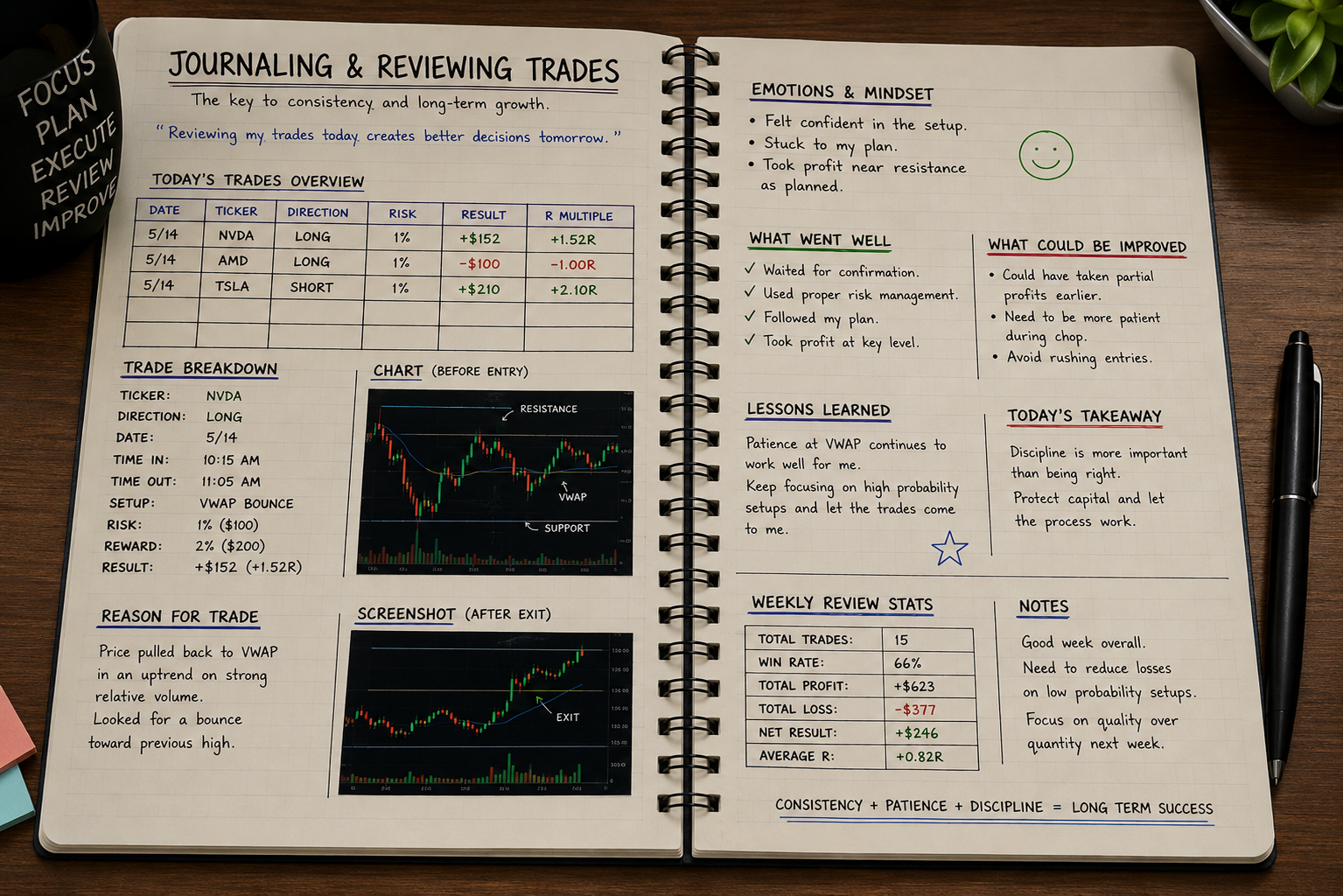
Journaling and reviewing trades are one of the most important habits professional traders develop over time. Many beginners focus only on entering trades and making money, but experienced traders understand that long term improvement comes from studying performance, identifying mistakes, and learning from both wins and losses.
A trading journal helps traders track patterns in their decision making, emotions, execution, discipline, and overall consistency. Without reviewing trades, many traders continue repeating the same mistakes over and over without realizing it.
Professional traders often record important details about every trade. This can include the ticker symbol, entry price, exit price, position size, setup type, risk level, time of entry Time of exit, and the reason for taking the trade. Many traders also take screenshots of charts before and after the trade to review structure an execution later.
Emotional review is also a major part of journaling. Traders often write down how they felt during the trade, whether they followed their plan, whether fear or greed affected decisions, and whether they remained disciplined during market volatility. This helps traders recognize emotional patterns that may be hurting performance.
One of the biggest benefits of journaling is identifying strengths and weaknesses. Traders may discover that certain setups consistently work better for them while others repeatedly fail. They also notice problems such as chasing stocks, revenge trading, entering too early, ignoring stop losses, or over trading during emotional periods.
Professional traders use journals to improve consistency. Instead of focusing only on profits and losses, they focus on the quality of execution and whether they follow their trading plan correctly. A good trade can still lose money, and a bad trade can still make money temporarily. Journaling helps traders focus on process instead of random outcomes.
Reviewing trades after the market closes is an important part of professional development. Many traders spend time studying charts, analyzing entries and exits, reviewing risk management decisions, and identifying what could be improved the next day. Small improvements over time can create major long-term growth.
Trading journals also help traders build discipline and accountability. Writing down decisions forces traders to become more honest about their actions, mistakes, and emotional reactions. This often reduces impulse behavior and encourages more structured decision making.
Screenshots are extremely useful during trade review. Many professional traders save chart images showing support and resistance levels, VWAP reactions, trend structure, volume behavior, and overall market conditions during the trade. Reviewing visual examples helps reinforce pattern recognition and execution skills.
Patience and emotional control are often strengthened through journaling. Traders who consistently review mistakes become more aware of emotional triggers such as fear, greed, frustration, revenge trading, and impulsive entries. Over time this self-awareness can simply improve discipline and consistency.
The goal of journaling is not perfection. The goal is continuous improvement, self-awareness, discipline, and long-term growth. Professional traders understand that becoming consistently profitable is a process that requires consistent learning and honest self-evaluation.
The best traders combine journaling, trade review, discipline, risk management, VWAP, volume analysis, trend structure, emotional control, and preparation together to create long term professional trading habits.

MOO-MOC Orders Understanding Institutional Order Flow
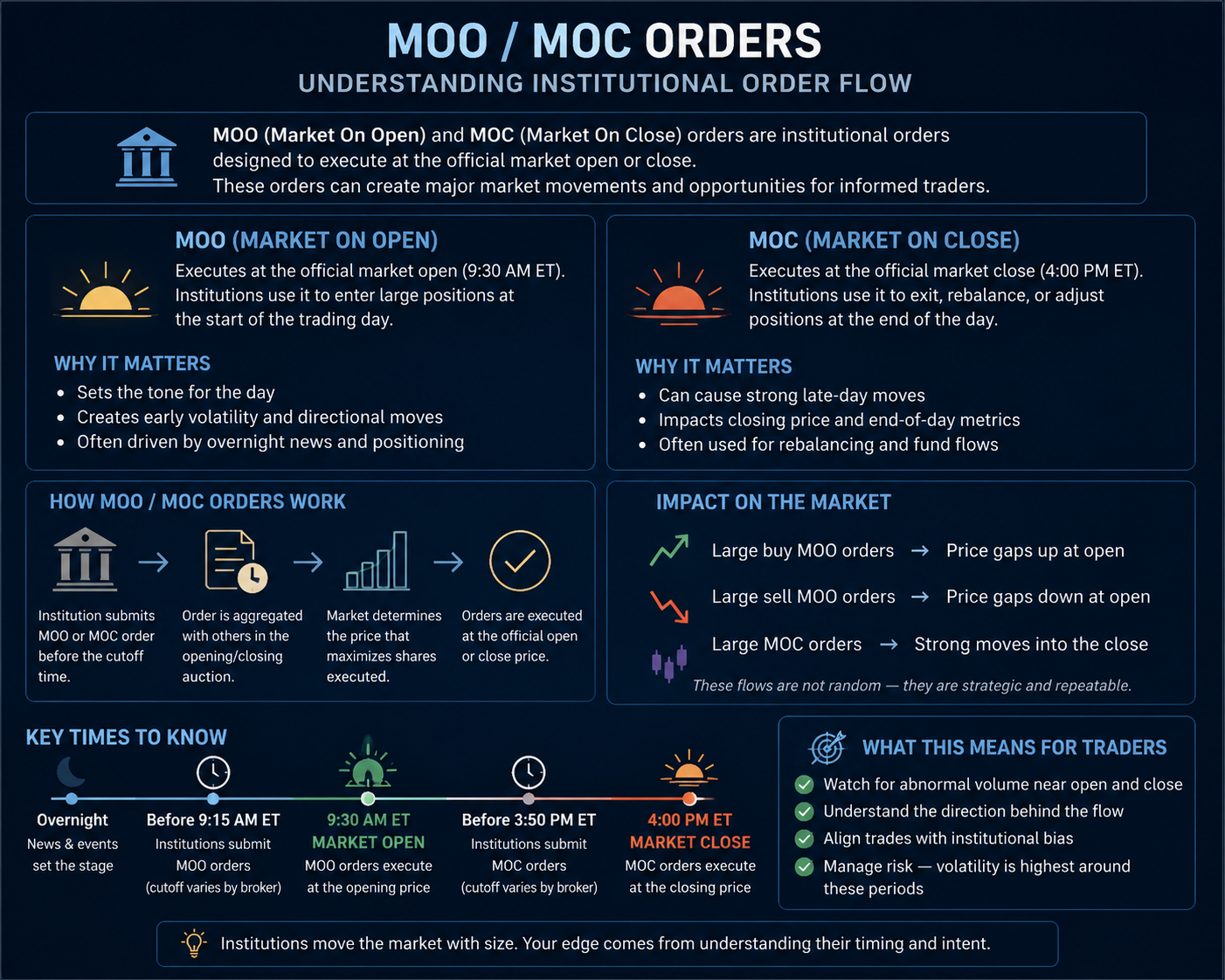
At first, MOO and MOC orders may sound confusing or overly advanced but understanding them can give traders a major advantage in the market. These order types are heavily used by institutions, hedge funds, mutual funds, ETF, and professional traders enter or exit positions during the most important moments of the trading day. Many of the biggest price movements happens near the market open and near the market closed, which is why professional traders pay extremely close attention to these periods.
What is moo Order?
MOO stands for Market on Open. MOO order is an order designed to execute right at the official market open, officially around 9:30 AM Eastern Time. Traders using MOO orders want immediate execution as soon as the market opens, even if the exact price changes rapidly during those few seconds.
MOO orders are commonly used after overnight news, earnings reports, economic announcements, analyst upgrades or downgrades, and major market events. Because institutions may be placing millions of dollars into positions at once, MOO orders can create strong opening momentum, sharp volatility, gap up, gap downs, and emotional trading conditions. This is one reason why the market open is considered one of the most volatile and dangerous times of the trading day for beginners.
Why institutions use MOO orders
Large institutions often cannot slowly enter positions the way smaller traders can. They may need immediate exposure through a stock due to overnight developments, portfolio adjustments, or rapidly changing market conditions. Because of this, institutions frequently use MOO orders to quickly establish positions at the opening bell.
Professional traders closely monitor pre–Market Volume, relative strength, gap scanners, news catalysts, and opening range breakouts because these can reveal institutional activity. When a stock opens with unusually high volume and strong momentum, this is often a sign that larger money is entering the market.
What is an MOC order?
MOC stands for Market on Close. These orders are executed near the closing bell, typically around 4:00 PM Eastern Time. MOC orders are extremely important because they can reveal how institutions are positioning themselves going into the next training day.
Professional traders pay close attention to the market close because large funds often rebalance positions late in the day. Institutions may accumulate or distribute shares during the final hour, as strong closers can sometimes signal continuation into the following session while weak closes may signal selling pressure.
The final hour of trading is commonly referred to as power hour because volume often increases significantly, Institutional activity becomes heavier, and momentum can accelerate rapidly. Many experienced traders focus heavily on this. Because some of the cleanest and strongest moves of the day occurred during the final hour.
Market in balance and institutional flow:
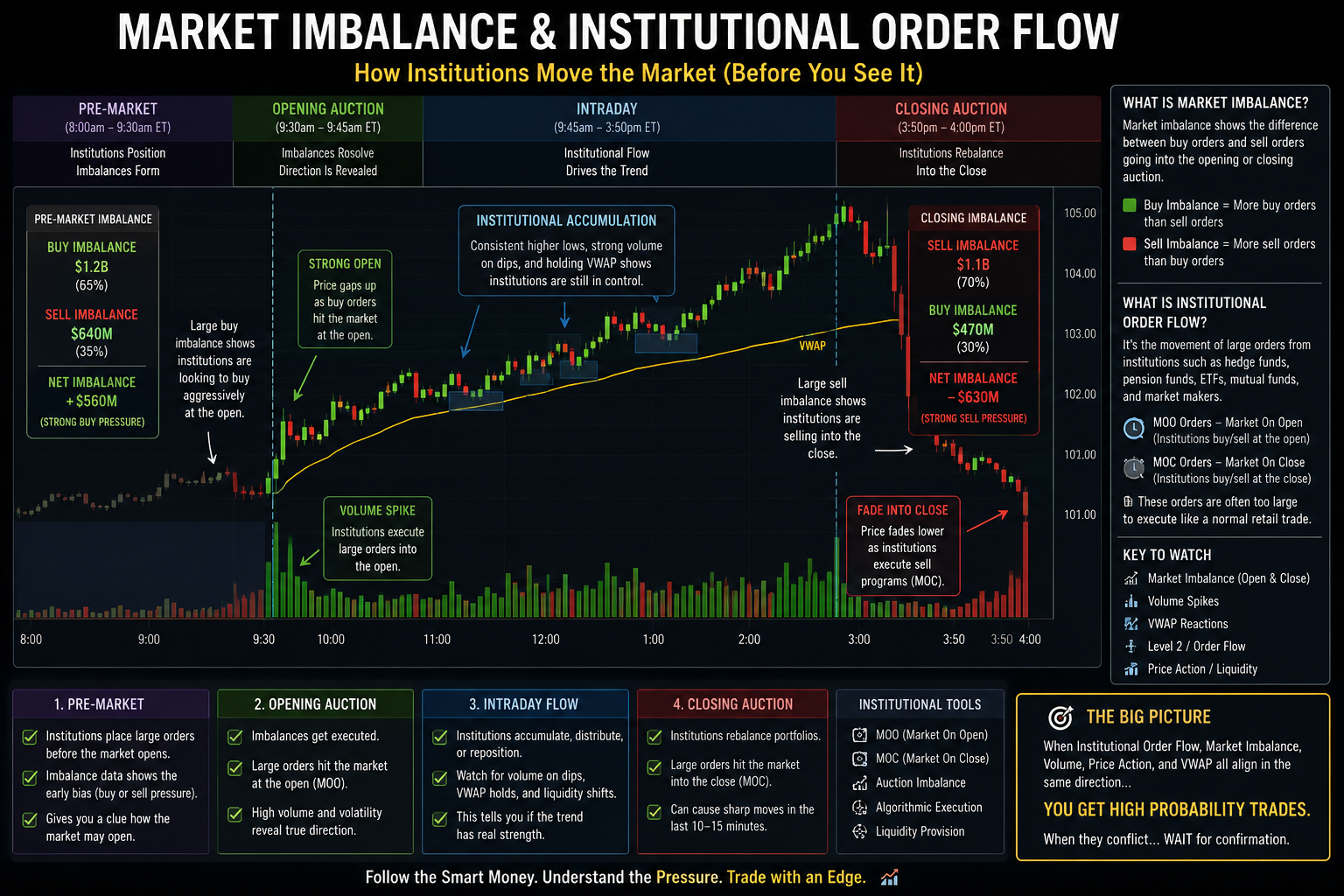
Market imbalances occur when there is significantly more buying or selling pressure on one side of the market. These imbalances become especially important near the open and close because institutions may be entering or exiting extremely large positions.
A strong buy imbalance can indicate aggressive institutional demand and bullish settlement, while a heavy sell in Dallas may indicate distribution, profit asking, or institutional selling pressure. Understanding market imbalance helps traders better interpret sudden spikes, trend continuation, reversals, large volume candles, and clothing strength or weaknesses.
Many professional traders believe the market is heavily influenced by institutional order flow and learning how to recognize this activity is an important step towards understanding advanced market behavior.
How traders use MOO and MOC information experienced traders use MOO and MOC concepts to better understand volatility momentum, institutional behavior, and trend continuation. Traders often study premarket gaps, relative volume, opening volatility, closing strength, power hour momentum, and signs of institutional accumulation or distribution to improve timing on entries and exits.
The goal is not simply to react emotionally to fast movement, but to understand why the movement may be happening in the first place. Learning to interpret water flow and market behavior can help traders make more disciplined and informed decisions.
Final thoughts
MOO and MOC actively can create some of the largest and fastest moves in the market. While these periods can offer major opportunities, they can also be extremely risky for traders who lack discipline or a clear pant plan.
Risk management should always come first period traders should focus on protecting capital, waiting for confirmation, avoiding emotional decisions, and concentrating on high quality setups rather than chasing movement. Learning institutional order flow is one of the 1st steps towards thinking like a professional trader instead of reacting emotionally like the crowd.

How to interpret real-time news
One of the most common mistakes made by new traders is assuming that every news headline deserves immediate action. In reality, the financial markets are flooded each day with press releases, promotional announcements analysis opinions, recycle stories, interviews, social media discussions, regulatory filings, earnings reports, and company updates, many of which have very little lasting effect on a company's true value. Successful traders learn that the objective is not simply to read the news first, but to understand its significance before risking capital. The market frequently reacts with emotion during the first few minutes after a headline appears, yet emotional reactions often differ from rational analysis. A disciplined trader develops the habit of asking whether the information fundamentally changes the company's outlook or merely creates temporary excitement. The ability to distinguish meaningful information from market noise is one of the foundations of professional trading and often separates Consistently successful traders from those who repeatedly chase headlines.
Not all news carries the same weight. Some announcements have the potential to change a company's future, while others simply generate short-term excitement. Examples of generally significant news include quarterly earnings that substantially beat or miss expectations, guidance that raises or lowers future revenue forecasts, FDA approvals for biotechnology companies, the announcement of a major customer or government contract, a merger or acquisition, the hiring or resignation of a key executive, significant legal rulings, bankruptcy filings, major debt restructuring, regulatory approvals or investigations, large share buyback programs, dividend increases or suspensions, and substantial inside buying or selling. These events can materially affect a company's financial outlook and are therefore closely monitored by institutional investors. By contrast, announcements about attending an investor conference, opening a new office, signing a non-binding letter of intent, launching an exploratory artificial intelligence initiative without financial details, receiving vague industry recognition, or issuing highly promotional press releases often have far less long-term significance, even if they briefly attract buyers.
Consider the difference between a company announcing record quarterly earnings that's substantially exceed expectations and another company issuing a press release stating that it will” Explore Artificial Intelligence opportunities.” The first announcement contains measurable financial information that may reasonably alter future estimates of revenue, profitability, and business growth. Large institutions may decide to reevaluate the company's value based on these results. The second announcement may sound exciting, but unless it contains specific details explaining how artificial intelligence will generate measurable revenue or improve profitability, it may represent little more than an attempt to attract investor attention. Likewise, if a pharmaceutical company receives final regulatory approval to sell a new drug, that announcement may have meaningful long-term implications. On the other hand, if a small company simply announces that it has” entered discussions” Regarding a possible future partnership without any binding agreement, the market may initially react with enthusiasm before realizing that very little has actually changed.
Another important question is whether the information is generally new. Markets constantly process information, as stock prices often began adjusting long before many traders noticed the headline. It is common to see news services publish articles describing events that occurred hours, days, or even weeks earlier. A trader who purchases a stock simply because they had personally discovered the news may unknowingly be reacting after thousands of other market participants have already incorporated that information into price. Before placing a trade, determine when the announcement was originally released and whether today's movement represents a new development or simply renewed attention to an old story. In many cases, a recycled headline creates only a temporary spike before sellers regain control.
The source of the information also deserves careful evaluation. Official regulatory filings, audited earnings reports, government approvals, and formal company announcements generally carry greater weight than rumors, anonymous social media posts, opinion articles, promotional newsletters, or Internet message boards. A headline quoting unnamed sources should could naturally be viewed with greater caution than one supported by verifiable documentation. Professional traders continuously evaluate not only what is being reported but also who is reporting it and whether the source has demonstrated reliability overtime. The credibility of the information is often as important as the information itself.
Price action should always be evaluated alongside the news itself. A headline may appear overwhelmingly positive, yet the stock may struggle to hold its gains, experience unusually heavy selling pressure, or begin declining despite continued optimistic commentary. Conversely, a stock may receive disappointing news but recover quickly because the negative information had already been anticipated by the market. There are also occasions when a stock rises dramatically on relatively minor news simply because of a small public float, aggressive momentum traders, or a short squeeze, these situations demonstrate that price movement alone does not prove the underlining news is important. The chart, trading volume, and the market’s reaction often provide a clearer picture than the headline itself.
Traders should also become familiar with promotional language. Financial press releases frequently contain words such as” Transformational,”” Strategic,”” Breakthrough,” Initiative,” Revolutionary,” AI-powered,” Or” Industry-leading.” Although these terms may sound impressive, they are not evidence that the company has become more valuable. A disciplined trader asked whether the announcement includes measurable facts. Doesn't identify the value of a contract? Does it provide revenue projections? Has a Regulatory agency granted approval? Has the company reported actual financial improvement? Has management Provided verifiable numbers? Without objective evidence, impressive language alone should never be interpreted as proof that a stock deserves a higher validation.
It is equally important to understand that not all positive news produces higher prices, and not all negative news produces lower prices. Suppose a biotechnology company receives regulatory approval for a new treatment after months of public anticipation. Because many investors expected the approval, the event may already be reflected in the stock price. Resulting in a sharp decline immediately after the announcement has traders lock in profits. Conversely, a company may report disappointing earnings, yet its stock rises because the results were significantly better than investors had feared. Financial markets react not simply to whether news is good or bad, but to whether the news is better or worse than what investors were already expecting.
Perhaps the most valuable question a trader can ask before entering any position is this: With a large institutional investor view this announcement as significant enough to change the company's long-term value? Institutions managing billions of dollars generally focus on earnings, revenue growth, competitive advantages, cash flow, debt levels, regulatory developments, major contracts, and other measurable business fundamentals. If the answer is no, the headline may generate temporary volatility but is less likely by itself, to support a sustained move. Thinking this way, I encourage you to analyze the quality of the information rather than simply reacting to its emotional impact.
Developing the ability to interpret news objectively requires patience, repetition, and continuous observation. Overtime, you will begin recognizing patterns that distinguish meaningful catalysts from promotional announcements, genuine business developments from recycled stories, and lasting opportunities from short lived speculation. While no method can guarantee a profitable trade, approaching every headline with discipline, skepticism, and careful analysis places you in a far stronger position than simply reacting to the latest breaking news. The objective is not to be the first person to read a headline, but to become one of the few traders who accurately understands what that headline is truly worth.

Market Imbalance & Institutional Order Flow
One of the most important lessons in this course
Most retail traders spend years focusing only on indicators Candlestick patterns, and random social media alerts while completely overlooking institutional order flow and market imbalance The forces that often drive the market underneath the surface.
Most beginner traders and even many traders that trade actively every single day do not fully understand market imbalance or institutional order flow. In many cases, it takes traders years before they even hear about these concepts, let alone truly understand how powerful they are.
In this free section, I'm going to introduce you to the foundation of how the market imbalance and institutional order flow work so you could begin understanding what is really moving the market underneath the circles.
In my PRO course, I go into extreme detail on the subject. I break down how professional traders monitor institutional buying and selling pressure, opening and closing action activity, liquidity shifts, level 2 behavior, living strength and weakness com MOO MOC Order flow, VWAP rejections, market maker behavior, and how large funds position themselves throughout the trading day.
Most retail traders spend all their time looking at indicators while completely ignoring what is actually driving price movement. Institutional money flow and supply and demand.
This section it's important because it teaches you how to think more like a professional traders and institutions instead of reacting emotionally like the average retail trader.
The market does not move simply because the chart looks bullish or because people in the chat room are excited. Stocks move because real money is entering or leaving positions. Large institutions, hedge funds, pension funds, ETFs, mutual funds, and market makers can move enormous amounts of capital through the market, and these orders often create powerful directional pressure at the open and close of the trading day.
That pressure can appear through MOO orders, MOC orders, market imbalance data, unusual volume, aggressive buying or selling on level 2, VWAP reactions, liquidity shifts, and strong directional moves in major stocks and indexes.
Most beginners never learn this because there are usually taught surface level trading concepts without understanding what is actively driving the move underneath the chart. Once you begin understanding institutional order flow, you start realizing why certain breakouts succeed, why some fail instantly, why some dips get bought aggressively, and why some stocks continue trending far longer than most people expect.
Professional traders pay extremely close attention to these areas because they can reveal hidden buying pressure, hidden selling pressure, and where large money may be positioning before the rest of the market reacts.
This is why traders constantly monitor stocks like Nvidia Corporation, Apple, Microsoft Corporation, Amazon, Meta platforms, Tesla, and S&P 500 ETF TRUST (SPY), and INVESCO QQQ Trust during the open and close. These names often reveal where institutional money is slowing and where the market may be leaning directionally.
The goal is not to blindly chase every imbalance or every large order. The goal is to learn how to read the pressure, compare it with volume, price action, VWAP, level 2, and overall market conditions, and then determine whether the move has real strength behind it.
Once you understand market imbalance an institutional order flow, you begin seeing the market very differently than the average trader.
This free course is only touching the surface of market and balance and institutional order flow because these subjects become extremely advanced at higher levels. In the pro course I go into extreme detail on how professional traders interpret institutional buying and selling pressure, liquidity shifts action activity, MOO and MOC Order flow, level 2 behavior, and Market direction in order to help give you a real edge in the market.

Bonus Section Real Winning
In this section, I break down real market examples to show how professional trading concepts are applied in live market conditions.
Many traders on the stand concepts and theory but struggle once the market opens and emotions, volatility, speed, and pressure begin affecting decision making. Deception is designed to help bridge the gap between theory and real execution.
These examples will demonstrate how traders Analyze,
Price action
Volume
VWAP reactions
Level 2 behavior
Market imbalance
Institutional order flow
Entry timing
Exit timing
Risk management
Trade philosophy
The goal is not just to show winning trades. The goal is to help you understand why the trades worked, what confirmations were present, how risk was managed, help professional traders interpret market conditions in real time periods.
In the pro, these examples become far more advanced with deeper explanations, institutional flow analysis, live breakdowns, and high probability setup recognitions.
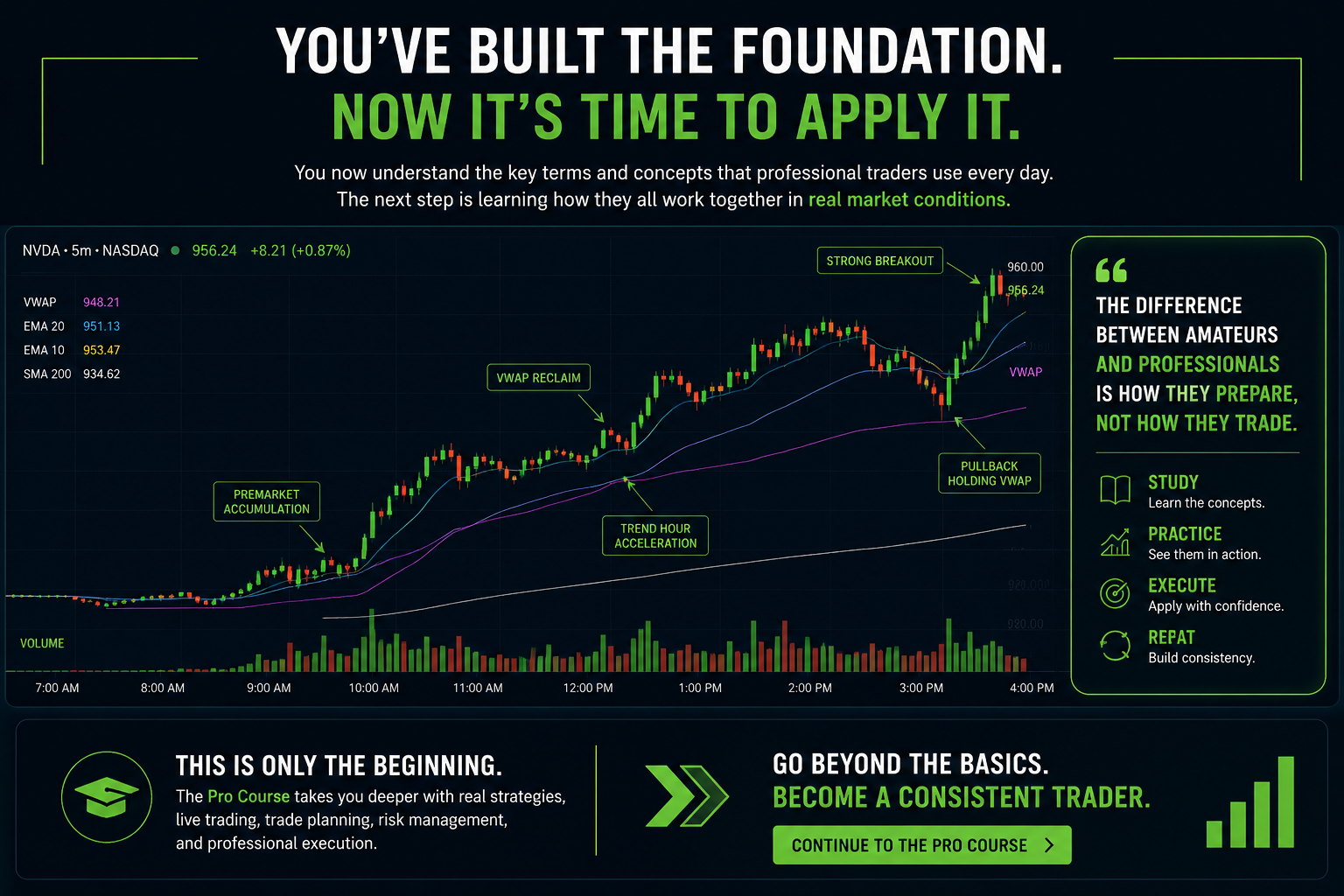
NVDA VWAP reclaim example -
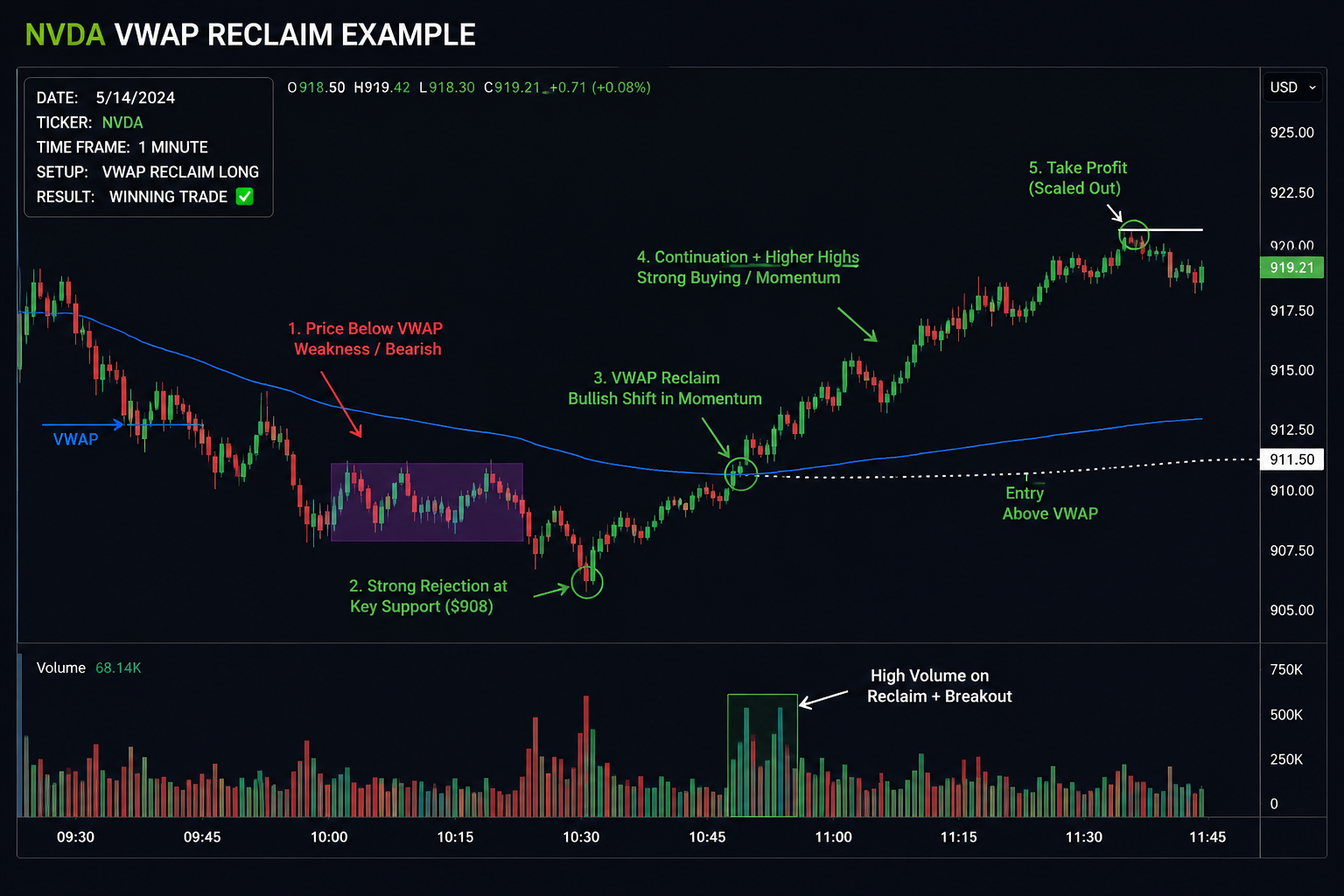
In this example, NVIDIA initially traded below VWAP, showing weakness during the early part of the session, but as buyers stepped in near support, volume increased and momentum began shifting higher. The key signal occurred when Nvidia reclaimed VWAP with strong buying pressure and continued holding above the level, while higher lows, stronger candles, and increasing volume confirm that buyers were gaining control. This setup demonstrates how traders combine VWAP, price action, volume, and momentum to identify potential high probability entries instead of trading emotionally. In the PRO course I go into much deeper detail on advanced VWAP reclaimed setups, institutional accumulation, entry timing, and trade management.
Spy Opening Breakout Example
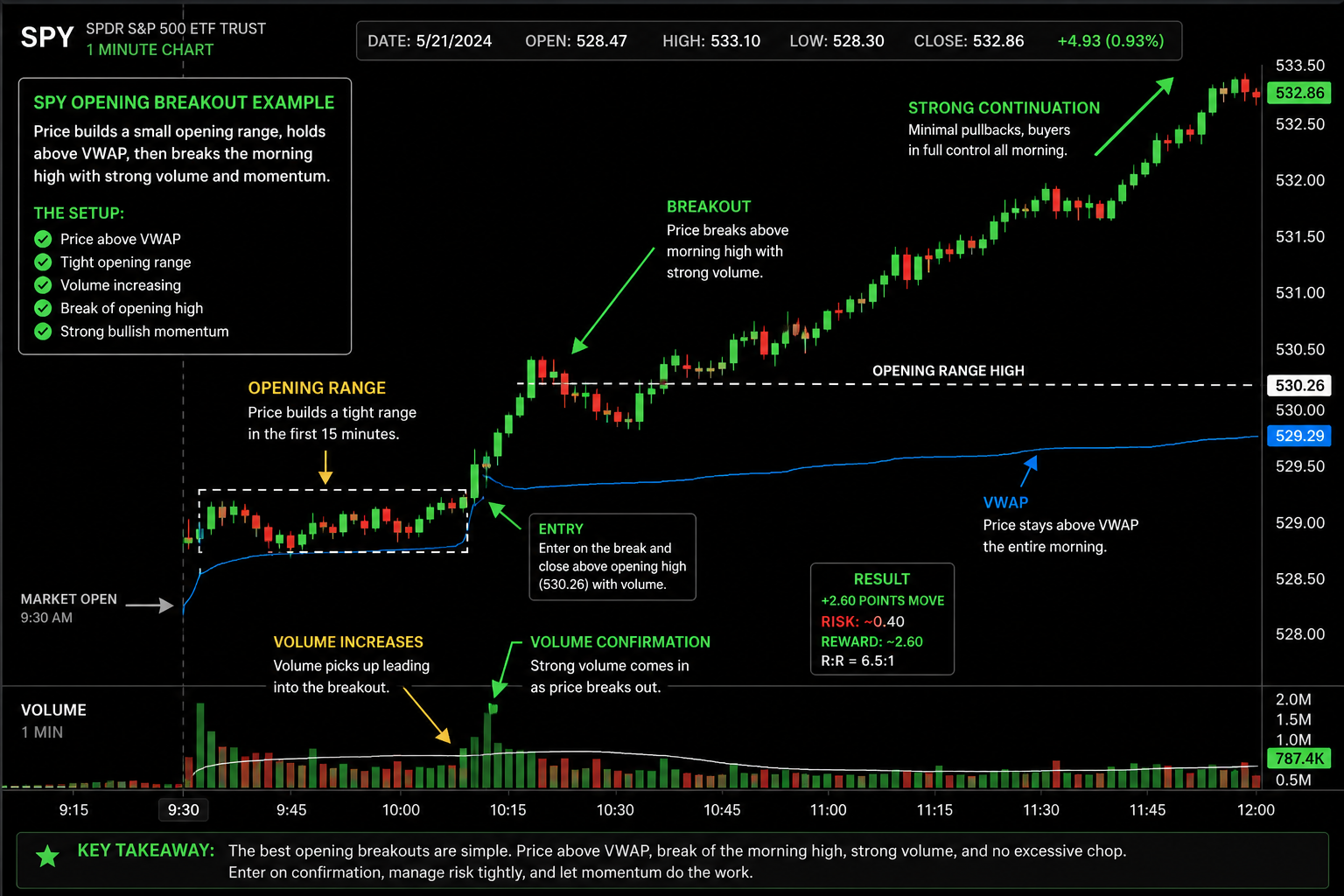
The spy opening breakout is one of the cleanest and most reliable setups in day trading because it shows early momentum and clear buyer control right after the market opens. In this example, SPY forms a tight opening range while holding above VWAP, showing strength instead of weakness. As volume begins increasing, price pushes through the morning high and confirms the breakout. The best opening breakouts usually happen when the stock is above VWAP, volume expands into the move, and candles continue making higher highs with very little pullback. Instead of guessing direction, traders wait for the confirmation and momentum before entering. This setup is popular because it proves clear entries, strong continuation potential, and defined risk levels while allowing traders to follow the strength already shown by the market.
How to spot institutional buying
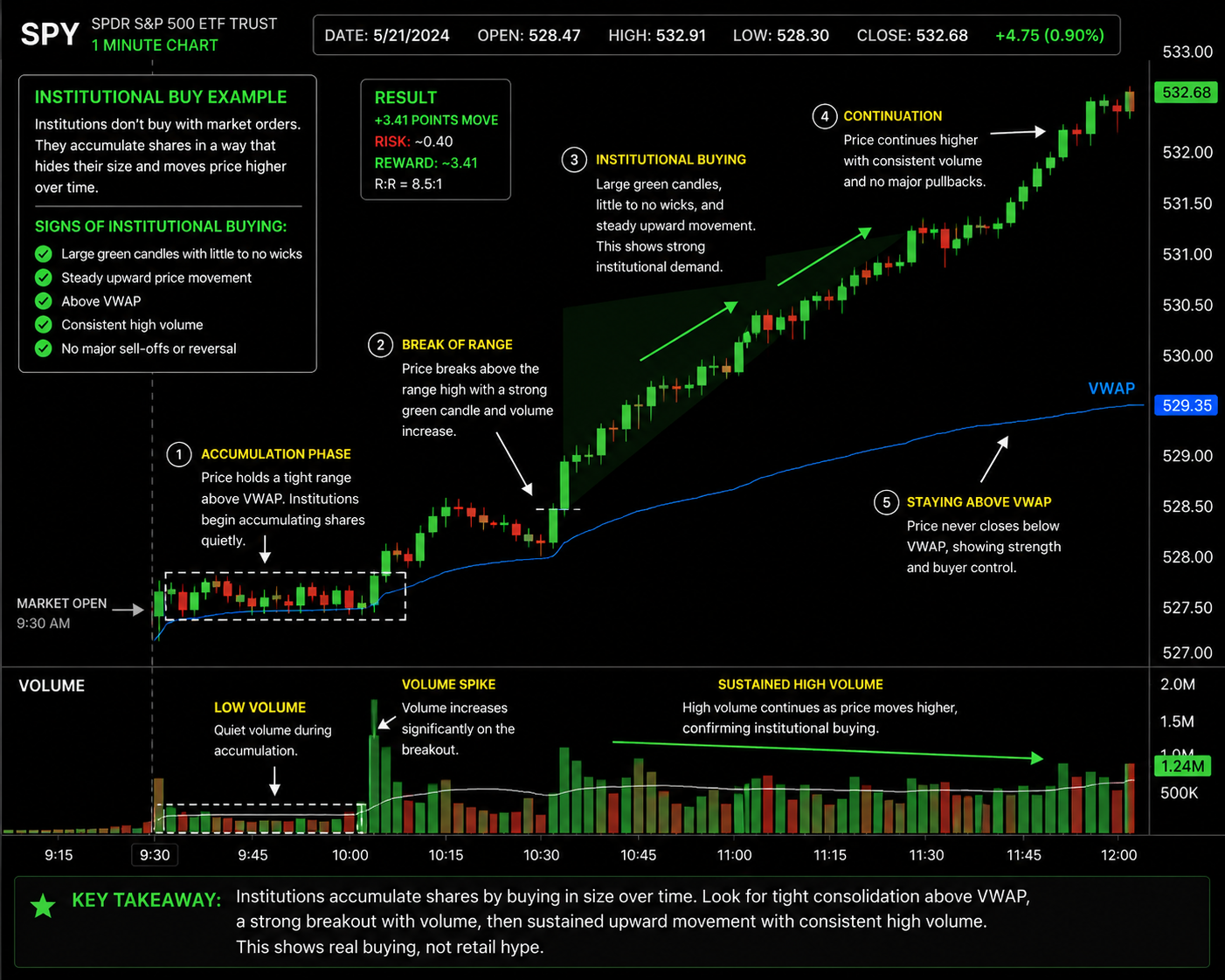
Institutional buying is one of the most important concepts in trading because large funds, banks, and professional traders move the market with size and volume. Institutions usually do not buy all at once, they accumulate shares over time while trying not to move the price too aggressively. This often creates tight consolidations above VWAP, Steady upward movement, strong volume increases, and multiple candles with little selling pressure. When institutional demands enter a stock, price tends to continue trading higher because the buying pressure is much larger than normal retail activity. Learning to recognize these signs can help traders align themselves with the direction of real money flow instead of chasing random momentum or emotional moves.

Trading Terms Index
MOO Market on Open
An order designated to execute right when
the market opens at 9:30 AM Eastern.
Moc market on close
An order designed to execute near the
closing bell.
Market imbalance
Occurs when buy orders greatly outweigh
sell orders, or vice versa.
VWAP
Volume weighted average price
Shows the average price a stock has
traded throughout the day, adjusted
for volume.
EMA
Exponential moving average
A moving average that reacts faster to
recent price action. Commonly used 10
EMA and 20 EMA.
SMA
Simple moving average
The average stock price over A. Of time.
The 200 SNA is widely watched.
Macd
Moving average convergence this
convergence
A momentum indicator that helps
identify
trend direction, momentum shifts,
and possible
reversals.
Atr
Average true Range
Measures how much a stock typically
moves
during a trading session.
Level 2
Real time bid and ask orders from market
participants. Used to identify buying slash
selling pressure, support, and resistance.
Tape reading
Watching real time transactions print on
the time and sales window to see the
position, size, and aggressiveness of buyers
and sellers.
Candlesticks
Visually display price movement during
a specific period of time Open, high, low.
Support
A price level where buyers may step in and
prevent the stock from falling lower.
Resistance
A price level where sellers may step in and
prevent the stock from moving higher.
Breakout
Occurs when a stock moves above a
major resistance
area with strong momentum and volume.
Breakdown
Occurs when a stock falls below an
important support level.
Reclaim
Happens when a stock loses an important
level and then moves back above it.
Dip and rip
Buying a strong stock after an early
pullback when momentum returns.
Trend hour
Usually refers to the period between 10 10:00 AM 10:40 AM Eastern, when stocks often establish a clearer trend.
Power Hour
The final hour of the trading day when volume and volatility often increased significantly.
Premarket
Trading that occurs before the regular market opens. Many traders watch free market for opportunities.
After hours
Trading that occurs after the market closes, heavily influenced By, News, institutional positioning.
Volume
Shows how many shares are being traded. High volume often confirms that a move is strong and meaningful.
Relative volume (RVOL)
Compares current trading volume to the stock's normal average volume.
Float
The number of shares available for public trading.
Low flow stock
A smaller number of shares available to trade. Which can create extreme volatility and fast price movements.
Large Cap stock
A company with a very large market capitalization, such as many of the Mag 7.
Market cap
Total value of a company equals share price X outstanding shares.
Institutional buying
Large purchases made by institutions such as hedge funds, mutual funds, and pension funds.
Scalping
A short-term trading strategy focused on taking small profits repeatedly.
Swing trading
Holding positions for multiple days or weeks to capture larger moves.
Risk management
Controlling losses position sizing and protecting trading capital.
Stop loss
A predetermined exit level designed to limit losses on the trade.
Position size
The number of shares or contracts a trader chooses to enter on a trade.
Bullish
A trader believes the stock or market is likely to move higher.
Bearish
A trader believes the stock or market is likely to move lower.

The Free Course Thought You The Language
The PRO Course Teaches You How To Read The Market
Congratulations on completing the free course.
Most people never even make it this far. Most people open a trading app, throw money into the market, follow random options online, and hope for the best without ever taking the time to truly understand what they are looking at. Very few people actually slow down and study the market itself. Very few people learn the language behind price movement, momentum, volume, psychology, an institutional activity. By completing this course, you have already separated yourself from the majority of beginner traders because you made the decision to start building a real foundation instead of relying on height, emotions, or build guessing.
You have now been introduced to many of the core concepts that professional traders use every day. You've learned about VWAP, moving average, support and resistance, market imbalance, momentum, volume, trend structure, risk management, institutional buying and selling pressure, and many of the foundations that drive the market on a daily basis. At first, some of these concepts may have sounded confusing or even overwhelming. That is completely normal. Every experienced trader once looked at charts and saw nothing but random movement. Every professional once struggled to understand candles, momentum, fake breakouts, and market behavior. The difference is that they stayed consistent long enough for the pieces to finally connect together.
Over time, something begins changing. The market starts looking different. What once looked random slowly starts making sense. You begin recognizing patterns, momentum shifts, emotional reactions, and areas where institutions may be positioning themselves. You stop seeing candles as random lines moving up and down and start seeing pressure, psychology, strength, weakness, fear, greed, and opportunity developing in real time. This is where trading slowly changes from gambling into understanding. This is where our confidence begins getting built not from hype or luck, but from repetition, education, preparation, and screen time.
This free course was designed to give you a real foundation. It was created to introduce you to the language of the market and help you understand what experienced traders are actually watching throughout the trading day. But the truth is that this is only the beginning. This course is only a small taste of what professional traders spend years learning and refining. The deeper levels of trading are not just about knowing what VWAP means or where support and resistance are located. The deeper levels involve understanding how these concepts work together under live market pressure, how institutions move money, how momentum develops, how false breakouts trap traders, how emotions affect execution, and how experienced traders stay disciplined while most people panic.
The PRO course is where everything begins connecting together at a much deeper level. This is where you begin learning how to apply these concepts in real market conditions instead of just understanding definitions on a page. This is where strategy, timing, execution, discipline, patience, and psychology begin coming together. You will start understanding why some traders can look at the exact same chart as everyone else and immediately recognize opportunity while others only seek confusion. The difference is not luck. The difference is preparation, education, and experience. Professional traders study the market differently. They study momentum, volume confirmation, liquidity, market structure, institutional behavior, and the emotional crowd reactions. They understand That consistency Is built slowly overtime through discipline and repetition.
Most traders lose because they never develop a real process. They jumped from strategy to strategy. They chase hype. They follow random chat room alerts. They buy stocks without understanding volume, momentum, positioning, or risk management. They allow emotions to control their decisions. They panicked during pull backs and become greedy during breakouts. They treat trading like gambling instead of treating it like a skill that must be developed over time. The reality is that the market rewards preparation and understanding. The traders who survive the long term are usually the traders who stay patient enough to continue learning while everyone else quits.
The goal is not to become lucky for one day. The goal is to build real skill that can stay with you for the rest of your life. The market can completely change the direction of your future if you truly take the time to understand it. But like anything valuable in life, skill takes repetition. It takes discipline. It takes patience. It takes the willingness to continue studying while most people become distracted, emotional, or discouraged. The traders who succeed are not always the smartest people in the room. Many times, they are simply the people who refuse to quit learning.
The Pro course was built for traders who want to go beyond the basics. Traders who want more than surface level information. Trainers who want deeper explanations, real examples, advanced concepts, strategy breakdowns, market philosophy, institutional concepts, live education understanding, and a stronger overall understanding of how experienced traders interpret the market every single day. This is where the lessons become more advanced, more detailed, and more focused on real world application instead is simple introductions.
You do not need to become perfect overnight. Nobody does. The goal is simply to continue improving one step at a time while building knowledge, discipline, confidence, and experience. Every great trader started as a beginner. Every experienced trader once felt confused. Would separate successful traders from unsuccessful traders is often the willingness to stay consistent long enough for the understanding to finally click into place.
Keep studying. Keep practicing. Keep learning how to think differently from the crowd. Over time, the charts will begin making more sense. Your discipline will improve. Your confidence will grow. Your decision making will become sharper. You will begin recognizing opportunities faster and understanding the market on a much deeper level than most people ever do.
The PRO course also gives you access to a much deeper level of real time market education and live trading insight Instead of simply learning definitions and concepts, you'll be able to watch how experienced traders evaluate the market in real time during actual trading conditions. This includes live trading alerts, real time market analysis, watchlists, momentum evaluations, breakdowns of the market conditions, and detailed explanation of why certain stocks appear stronger or weaker than others. You'll begin learning how professional traders evaluate probability, volume, momentum, institutional activity, market settlement, and overall market structure to determine which stocks are more likely to move higher, which setups appear weak, and where opportunity may be developing throughout the trading day. Goal is not simply to throw out random alerts or hype stocks the goal is to help you understand the reasoning behind the trade, the setup, the timing, the risk and the overall market environment so you can begin developing the ability to think independently and recognize high probability opportunities on your own over time.
This is only the beginning of your journey.
Study. Practice. Execute. Repeat.
Continue to the PRO course when you are ready to take the next step.